A particle of charge $ - 16 \times {10^{ - 18}}$ $coulomb$ moving with velocity $10\,\,m{s^{ - 1}}$ along the $x$-axis enters a region where a magnetic field of induction $B$ is along the $y$-axis, and an electric field of magnitude ${10^4}\,\,V/m$ is along the negative $z$-axis. If the charged particle continues moving along the $x$-axis, the magnitude of $B$ is
AIEEE 2003, Medium
Download our app for free and get started
(b) Since particle is moving undeflected.
So $qE = qvB \Rightarrow B = E/v = \frac{{{{10}^4}}}{{10}} = {10^3}\,Wb/{m^2}$
So $qE = qvB \Rightarrow B = E/v = \frac{{{{10}^4}}}{{10}} = {10^3}\,Wb/{m^2}$

Download our appand get started for free
Experience the future of education. Simply download our apps or reach out to us for more information. Let's shape the future of learning together!No signup needed.*
Similar Questions
- 1View SolutionTo make the field radial in a moving coil galvanometer
- 2A solenoid of $N$ turn, $'l'$ length and $'r'$ radius of cross - section. If current $i$ flow in solenoid then magnetic field at axial mid point will be (where $l\, \simeq \,\,r$ )View Solution
- 3The magnetic field at a distance $r$ from a long wire carrying current $i$ is $0.4\, Tesla$. The magnetic field at a distance $2r$ is......$Tesla$View Solution
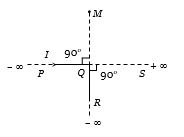
- 4An infinitely long conductor $PQR$ is bent to form a right angle as shown. A current $I$ flows through $PQR$ The magnetic field due to this current at the point $M $ is $H_1$. Now another infinitely long straight conductor $QS$ is connected at $Q$ so that the current is $I/2$ in $QR$ as well as in $QS$, The current in $PQ$ remaining unchanged. The magnetic field at $M$ is now ${H_{2.}}$The ratio ${H_1}/{H_2}$ is given byView Solution
- 5A uniform magnetic field acts at right angles to the direction of motion of electrons. As a result, the electron moves in a circular path of radius $2\, cm$. If the speed of the electrons is doubled, then the radius of the circular path will be.....$cm$View Solution
- 6Current $i$ is carried in a wire of length $L$. If the wire is turned into a circular coil, the maximum magnitude of torque in a given magnetic field $B$ will beView Solution
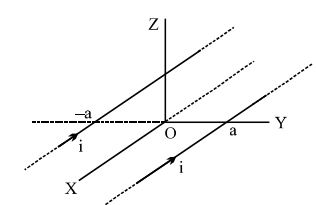
- 7Two long thin, parallel conductors carrying equal currents in the same direction are fixed parallel to the $x$-axis, one passing through $y = a$ and the other through $y = -a$. The resultant magnetic field due to the two conductors at any point is $B$. Which of the following are correct?View Solution
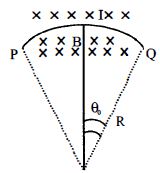
- 8A wire carrying current $I$ is tied between points $P$ and $Q$ and is in the shape of a circular arc of radius $R$ due to a uniform magnetic field $B$ (perpendicular to the plane of the paper, shown by $\times \times \times $) in the vicinity of the wire. If the wire subtends an angle $2\theta_0$ at the centre of the circle (of which it forms an arc) then the tension in the wire isView Solution
- 9A long straight wire carries a current of $35\; A$. What is the magnitude of the field $B$ at a point $20\; cm$ from the wire?View Solution
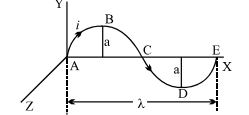
- 10A conductor $ABCDE$, shaped as shown, carries a current i. It is placed in the $xy$ plane with the ends $A$ and $E$ on the $x$-axis. $A$ uniform magnetic field of magnitude $B$ exists in the region. The force acting on it will beView Solution