Question
The separation between the objective and the eyepiece of a compound microscope can be adjusted between $9.8\ cm$ to $11.8\ cm$. If the focal lengths of the objective and the eyepiece are $1.0\ cm$ and $6\ cm$ respectively, find the range of the magnifying power if the image is always needed at $24\ cm$ from the eye.
Answer

For the given compound microscope $f_0 = 1\ cm, f_e = 6\ cm, D = 24\ cm$
For the eye piece$, v_e= -24\ cm, f_e = 6\ cm$
Now, $\frac{1}{\text{v}_\text{e}}-\frac{1}{\text{u}_\text{e}}=\frac{1}{\text{f}_\text{e}}$
$\Rightarrow\frac{1}{\text{u}_\text{e}}=\frac{1}{\text{v}_\text{e}}-\frac{1}{\text{f}_\text{e}}$
$\Rightarrow-\Big[\frac{1}{24}+\frac{1}{6}\Big]=-\frac{5}{24}$
$\Rightarrow \text{u}_\text{e}=-4.8\ \text{cm}$
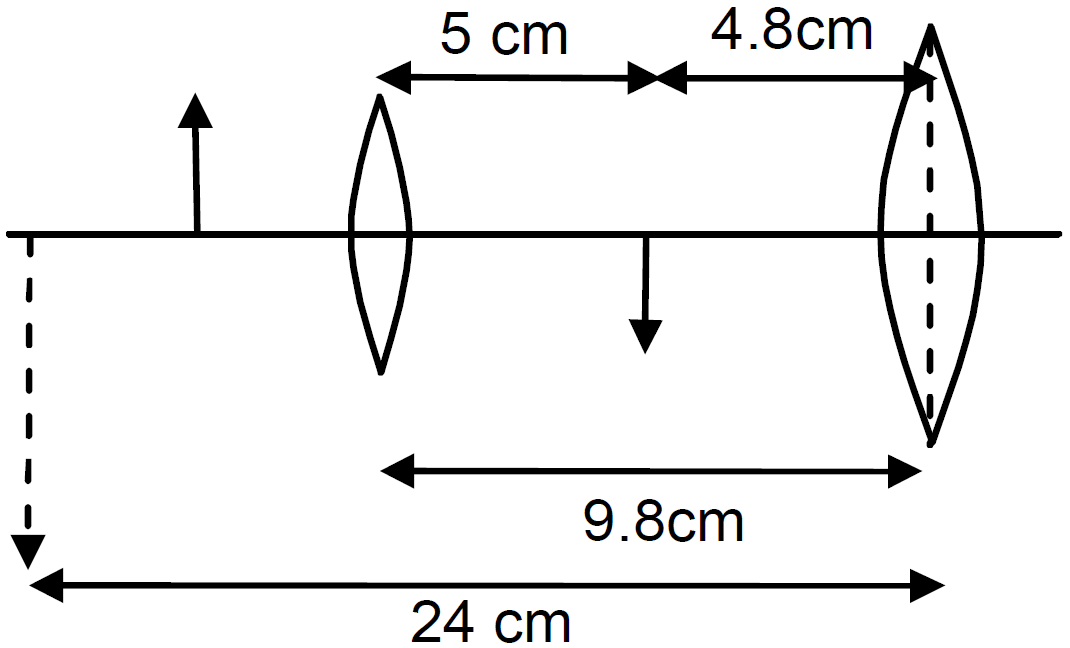
  1. When the separation between objective and eye piece is $9.8\ cm,$ the image distance for the objective lens must be $(9.8) - (4.8) = 5.0\ cm$
Now, $\frac{1}{\text{v}_0}-\frac{1}{\text{u}_0}=\frac{1}{\text{f}_0}$
$\Rightarrow\frac{1}{\text{u}_0}=\frac{1}{\text{v}_0}-\frac{1}{\text{f}_0}=\frac{1}{5}-\frac{1}{1}=-\frac{4}{5}$
$\Rightarrow\text{u}_0=-\frac{5}{4}=-1.25\text{cm}$
So, the magnifying power is given by,
$\text{m}=\frac{\text{v}_0}{\text{u}_\text{0}}\Big[1+\frac{\text{D}}{\text{f}}\Big]=\frac{-5}{-1.25}\Big[1+\frac{24}{6}\Big]=4\times5=20$
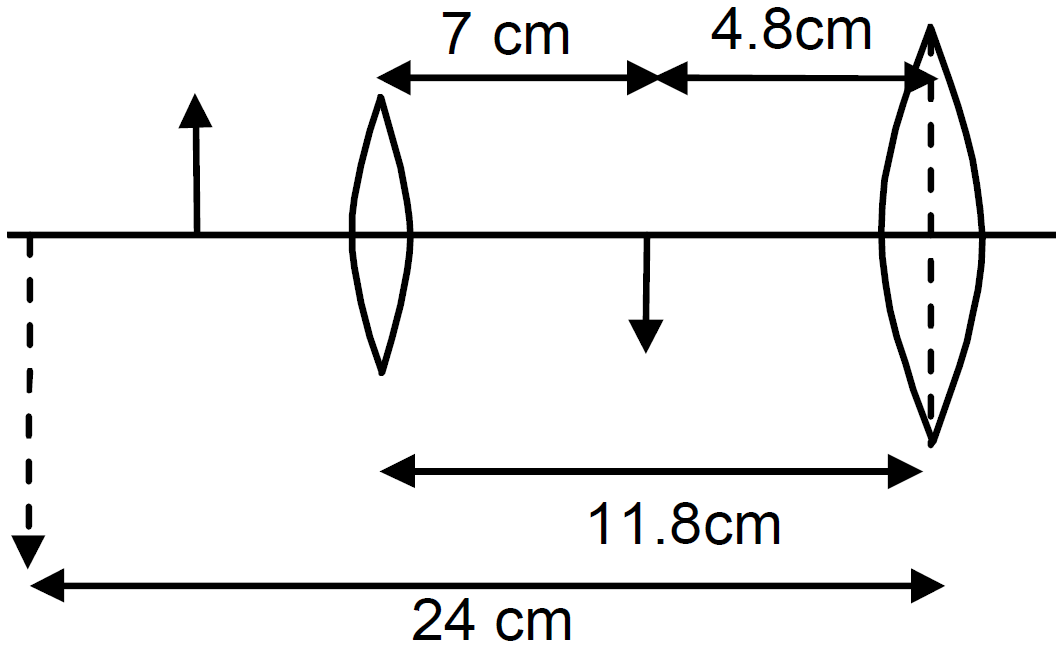
  1. When the separation is $11.8\ cm,$
$v_0 = 11.8 - 4.8 = 7.0\ cm, f_0 = 1\ cm$
$\Rightarrow\frac{1}{\text{u}_0}=\frac{1}{\text{v}_0}-\frac{1}{\text{f}_0}=\frac{1}{7}-\frac{1}{1}=-\frac{6}{7}$
So, $\text{m}=-\frac{\text{v}_0}{\text{u}_\text{o}}\Big[1+\frac{\text{D}}{\text{f}}\Big]$
$=\frac{-7}{-\Big(\frac{7}{6}\Big)}\Big[1+\frac{24}{6}\Big]=6\times5=30$
So, the range of magnifying power will be $20$ to $30.​​​​​​​$​​​​​​​

Need a full question paper?

Generate a complete, print-ready paper with questions like this in minutes — across 16+ boards, with answer keys.

Start Generating Free

Similar questions

A man of mass M having a bag of mass m slips from the roof of a tall building of height H and starts falling vertically. When at a height h from the ground, he notices that the ground below him is pretty hard, but there is a pond at a horizontal distance x from the line of fall. In order to save himself he throws the bag horizontally (with respect to himself) in the direction opposite to the pond. Calculate the minimum horizontal velocity imparted to the bag so that the man lands in the water. If the man just succeeds to avoid the hard ground, where will the bag land?
The half$-$life of $^{40}K$ is $1.30 \times 10^9y$. A sample of $1.00g$ of pure $\text{KCI}$ gives $160$ counts/ s. Calculate the relative abundance of $^{40}K\ ($fraction of $^{40}K$ present$)$ in natural potassium.
A glass vessel measures exactly $10\ cm \times 10\ cm \times 10\ cm$ at $0^\circ C$. It is filled completely with mercury at this temperature. When the temperature is raised to $10^\circ C, 1.6\ cm^3$ of mercury overflows. Calculate the coefficient of volume expansion of mercury. Coefficient of linear expansion of glass $= 6.5 \times 10^{-6 ^\circ} C.$
  1. Find the radius of the circular orbit of a satellite moving with an angular speed equal to the angular speed of earth's rotation.
  2. If the satellite is directly above the north pole at some instant, find the time it takes to come over the equatorial plane. Mass of the earth $= 6 \times 10^{24}kg.$
In en experiment on photoelectric effect, light of wavelength $400$ run is incident on a cesium plate at the rate of $5.0W.$ The potential of the collector plate is made sufficiently positive with respect to the emitter so that the current reaches its saturation value. Assuming that on the average one out of every $10^\circ$ photons is able to eject a photoelectron, find the photocurrent in the circuit.
The amount of charge that passes in time t through a cross$-$section of a wire is,
$Q(t) = At^2 + Bt + C.$
  1. Write the dimensional formulae for $A, B$ and $C.$
  2. If the numerical values of $A, B$ and $C$ are $5, 3$ and $1,$ respectively, in $S.I$ units, find the value of the current at $t = 5s.$
A person says that he measured the acceleration of a particle to be non-zero while no force was acting on the particle:
  1. He is a liar.
  2. His clock might have run slow.
  3. His meter scale might have been longer than the standard.
  4. He might have used non-inertial frame.
The separation between the plates of a parallel$-$plate capacitor is $0.500\ cm$ and its plate area is $100\ cm^2.$ A $0.400\ cm$ thick metal plate is inserted into the gap with its faces parallel to the plates. Show that the capacitance of the assembly is independent of the position of the metal plate within the gap and find its value.
  1. Obtain lens makers formula using the expression
  1. $\frac{\text{n}_{2}}{\text{v}} - \frac{\text{n}_{1}}{\text{u}} = \frac{(\text{n}_{2} - \text{n}_{1})}{\text{R}}$
    Here the ray of light propagating from a rare medium of refractive index $(n_1)$ to a denser medium of refractive index $(n_2)$ is incident on the convex side of spherical refracting surface of radius of curvature $R.$
  2. Draw a ray diagram to show the image formation by a concave mirror when the object is kept between its focus and the pole. Using this diagram, derive the magnification formula for the image formed.
A ball is whirled in a circle by attaching it to a fixed point with a string. Is there an angular rotation of the ball about its centre? If yes, is this angular velocity equal to the angular velocity of the ball about the fixed point?