MCQ
The set of all real values of $\lambda$ for which the quadratic equations, $\left(\lambda^{2}+1\right) x ^{2}-4 \lambda x +2=0$ always have exactly one root in the interval $(0,1)$ is
- A$(-3,-1)$
- ✓$(1,3]$
- C$(0,2)$
- D$(2,4]$
$\Rightarrow \quad f (0) \cdot f (1)<0$
$\Rightarrow \quad 2\left(\lambda^{2}-4 \lambda+3\right)<0$
$\Rightarrow \quad 1<\lambda<3$
Now for $\lambda=1,2 x ^{2}-4 x +2=0$
$(x-1)^{2}=0, x=1,1$
So both roots doesn't lie between (0,1)
$\therefore \lambda \neq 1$
Again for $\lambda=3$
$10 x^{2}-12 x+2=0$
$\Rightarrow \quad x=1, \frac{1}{5}$
so if one root is 1 then second root lie between (0,1)
so $\lambda=3$ is correct.
$\therefore \quad \lambda \in(1,3]$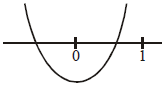
Generate a complete, print-ready paper with questions like this in minutes — across 16+ boards, with answer keys.