MCQ
The shaded region in the given figure is
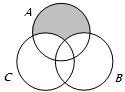
  • A
    $A \cap (B \cup C)$
  • B
    $A \cup (B \cap C)$
  • C
    $A \cap (B -C)$
  • $A -(B \cup C)$

Answer

Correct option: D.
$A -(B \cup C)$
d
(d) It is obvious.

Need a full question paper?

Generate a complete, print-ready paper with questions like this in minutes — across 16+ boards, with answer keys.

Start Generating Free

Similar questions

$\int_{ - 3}^3 {\frac{{{x^2}\sin x}}{{1 + {x^6}}}\,dx = } $
If ${x^4}$ occurs in the ${r^{th}}$ term in the expansion of ${\left( {{x^4} + \frac{1}{{{x^3}}}} \right)^{15}}$, then $r = $
The area formed by triangular shaped region bounded by the curves $y = \sin x,\,y = \cos x$ and $x = 0$ is
If the area of the region
$\left\{(x, y): 1+x^{2} \leq y \leq \min \{x+7,11-3 x\}\right\}$ is $A$, then 3 A is equal to
Let $I = \mathop \smallint \limits_0^1 \frac{{\sin x}}{{\sqrt x }}\;dx$ and $\;J = \mathop \smallint \limits_0^1 \frac{{\cos x}}{{\sqrt x }}\;dx$ Then which one of  the following is true?
Let  $f:(a, b) \rightarrow R$ be twice differentiable function such that $f(x)=\int_{a}^{x} g(t) d t$ for a differentiable function $g(x) .$ If $f(x)=0$ has exactly five distinct roots in $(a, b)$, then $g(x) g^{\prime}(x)=0$ has at least:
A line $l$ passing through the origin and perpendicular to the lines

${l_1} = \left( {3 + t} \right)\hat i + \left( { - 1 + 2t} \right)\hat j + \left( {4 + 2t} \right)\hat k,\, - \infty  < t < \infty $

${l_2} = \left( {3 + 2s} \right)\hat i + \left( {3 + 2s} \right)\hat j + \left( {2 + s} \right)\hat k,\, - \infty  < s < \infty $

Statement $1$ : Line $l$ and $l_2$ are coplaner lines

Statement $2$ : Line $l$ and $l_2$ are intersecting lines

The value of ${i^{1 + 3 + 5 + ... + (2n + 1)}}$ is
If $d = \lambda \,(a \times b) + \mu \,(b \times c) + \nu \,(c \times a)$and $[a\,b\,c] = \frac{1}{8},$ then $\lambda + \mu + \nu $ is equal to
If $2\, cos\theta + sin\theta = 1$, then the value of $4\, cos\theta + 3sin\theta$ is equal to