Question
The $SI$ unit of volume charge density is:

Answer

$C/m^{3}$

Need a full question paper?

Generate a complete, print-ready paper with questions like this in minutes — across 16+ boards, with answer keys.
Start Generating Free

Similar questions

The heating coils rating at 220 volt and producing 50 cal/sec heat are available with the resistances 55Ω,110 Ω, 220 Ω   and 440 Ω. The heater of maximum power will be of(a) 440 Ω(b) 220 Ω(c) 110 Ω(d) 55 Ω
       
A piece of copper and the other of germanium are cooled from the room temperature to 80 K, then which of the following would be a correct statement(a) Resistance of each increases(b) Resistance of each decreases(c) Resistance of copper increases while that of germanium decreases (d) Resistance of copper decreases while that of germanium increases


In any Bohr orbit of the hydrogen atom, the ratio of kinetic energy to potential energy of the electron is(a) 1/2(b) 2(c) -1/2   (d)  -2
       
If a body is charged by rubbing it, its weight
An electron is moving in the north direction. It experiences a force in vertically upward direction. The magnetic field at the position of the electron is in the direction of(a) East(b) West(c) North(d) South
       
The capacitance of a metallic sphere will be 1μF, if its radius is nearly(a) 9 km  (b) 10 m (c) 1.11 m (d) 1.11 cm
       
Select the correct statement (a) In a full wave rectifier, two diodes work alternately(b) In a full wave rectifier, two diodes work simultaneously(c) The efficiency of full wave and half wave rectifiers is same(d) The full wave rectifier is bi-directional.


When the current i is flowing through a conductor, the drift velocity is v. If  2i  current is flowed through the same metal but having double the area of cross-section, then the drift velocity will be(a) v/4(b) v/2(c) v  (d) 4v
       
A $4\mu F$ capacitor, a resistance of $2.5 M\Omega$ is in series with $12\ V$ battery. Find the time after which the potential difference across the capacitor is $3$ times the potential difference across the resistor. $[$Given ln$(2)= 0.693]$
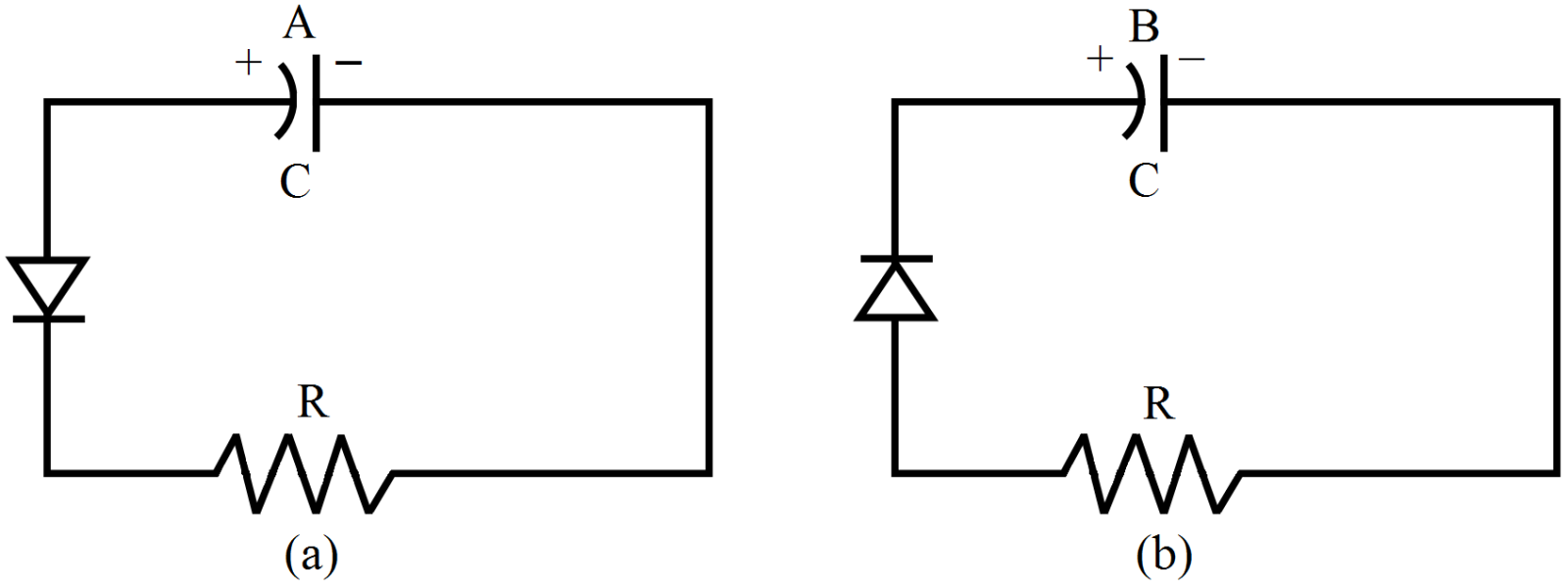
Two identical capacitors A and B are charged to the same potential V and are connected in two circuits at t = 0 as shown in figure. The charges on the capahltors at a time t = CR are, respectively:
  1. $\text{VC}, \text{VC}$
  2. $\frac{\text{VC}}{\text{e}}, \text{VC}$
  3. $\text{VC}, \frac{\text{VC}}{\text{e}}$
  4. $\frac{\text{VC}}{\text{e}}, \frac{\text{VC}}{\text{e}}$