MCQ
The smallest temperature difference that can be measured with a combination of a thermocouple of thermo $\text{e.m.f.} \ 30mV$ per degree and a galvanometer of $50 \ \mathrm{ohm}$ resistance, capable of measuring a minimum current of $3 \times 10^{-7}$ amp is
 
  • $0.5$ degree
  • B
    $1.0$ degree
  • C
    $1.5$ degree
  • D
    $2.0$ degree

Answer

Correct option: A.
$0.5$ degree
$0.5$ degree

Need a full question paper?

Generate a complete, print-ready paper with questions like this in minutes — across 16+ boards, with answer keys.

Start Generating Free

Similar questions

Two coherent sources $S_1$ and $S_2$ are separated by a distance four times the wavelength $l$ of the source. The sources lie along $y$ axis whereas a detector moves along $+ \ x$ axis. Leaving the origin and far off points the number of points where maxima are observed is
L, C and R represent the physical quantities inductance, capacitance and resistance respectively. Which of the following combinations have dimensions of frequency?
Two pure inductors each of self inductance L are connected in parallel but are well separated from each other. The total inductance is
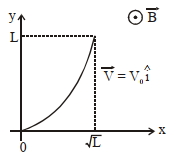
A conducting wire of parabolic shape, initially $y=x^2$, is moving with velocity $\overrightarrow{ V }= V _0 \hat{ i }$ in a nonuniform magnetic field $\vec{B}=B_0\left(1+\left(\frac{y}{L}\right)^\beta\right) \hat{k}$, as shown in figure. If $V_0, B_0, L$ and $\beta$ are positive constants and $\Delta \phi$ is the potential difference developed between the ends of the wire, then the correct statement(s) is/are:

$(1)$ $|\Delta \phi|$ remains the same if the parabolic wire is replaced by a straight wire, $y=x$ initially, of length $\sqrt{2} L$

$(2)$ $|\Delta \phi|$ is proportional to the length of the wire projected on the $y$-axis.

$(3)$ $|\Delta \phi|=\frac{1}{2} B _0 V _0 L$ for $\beta=0$

$(4)$ $|\Delta \phi|=\frac{4}{3} B_0 V_0 L$ for $\beta=2$

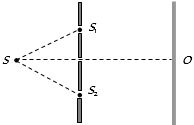
In the set up shown in Fig the two slits, ${S_1}$ and ${S_2}$ are not equidistant from the slit $S$. The central fringe at $O$ is then
When a current of $2\, A$ flows in a battery from negative to positive terminal, the  potential difference across it is $12\, V$. If a current of $3 \,A$ flows in the opposite  direction potential difference across the terminals of the battery is $15\, V$, the $emf$ of the  battery is ................ $\mathrm{V}$
A charge of $10^{-9}C$ is placed on each of the 64 identical drops of radius 2cm. They are then combined to form a bigger drop. Find its potential 
The electric potential at the centre of a charged spherical conductor in comparison with the potential at the surface of the conductor:
During the nuclear fusion reaction
Material A has critical angle ${i_A},$ and material $B$ has critical angle ${i_B}({i_B} > {i_A}).$ Then which of the following is true

$(i)$ Light can be totally internally reflected when it passes from $B$ to $A$

$(ii)$ Light can be totally internally reflected when it passes from $A$ to $B$

$(iii)$ Critical angle for total internal reflection is ${i_B} - {i_A}$

$(iv)$ Critical angle between $A$ and $B$ is ${\sin ^{ - 1}}\left( {\frac{{\sin {i_A}}}{{\sin {i_B}}}} \right)$