MCQ
The solid angle subtended by the total surface area of a sphere at the centre is:
- A$4\pi$
- B$2\pi$
- C$\pi$
- D$3\pi$
Explanation:
A steradian is the solid angle subtended at the center of a sphere of radius r by a section of its surface area of magnitude equal to r2. Since the surface area is $4\pi\text{r}^2$, there are $4\pi$ steradians surrounding a point in space.
Generate a complete, print-ready paper with questions like this in minutes — across 16+ boards, with answer keys.
A uniform conducting wire ABC has a mass of 10g. A current of 2A flows through it. The wire is kept in a uniform magnetic field B = 2T. The acceleration of the wire will be
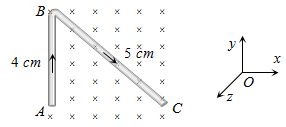
| (a) Zero |
(b) 12  along y-axis along y-axis
|
(c) 1.2  along y-axis along y-axis
|
(d) 0.6 along y - axis
|
A parallel plate capacitor carries a charge q. The distance between the plates is doubled by application of a force. The work done by the force is
|
(a) Zero |
(b) |
(c) |
(d) |
The Rutherford a-particle experiment shows that most of the a-particles pass through almost unscattered while some are scattered through large angles. What information does it give about the structure of the atom
|
(a) Atom is hollow |
|
(b) The whole mass of the atom is concentrated in a small centre called nucleus |
|
(c) Nucleus is positively charged |
|
(d) All the above |
In the circuit as shown in the figure the effective capacitance between A and B is

|
(a) 3 μF |
(b) 2 μF |
(c) 4 μF |
(d) 8 μF |
The ratio of areas within the electron orbits for the first excited state to the ground state for hydrogen atom is
| (a) 16 : 1 | (b) 18 : 1 | (c) 4 : 1 | (d) 2 : 1 |


