MCQ
The solubility of $AgCl$ is minimum in
  • A
    $AgNO_3\,(0.1\,M)$
  • $H_2O\,(l)$
  • C
    $NaCl\,(0.4\,M)$
  • D
    $BaCl_2\,(0.3\,M)$

Answer

Correct option: B.
$H_2O\,(l)$
b
Due to common ion /rea$^n$ will proceed in backward direction that why solubility is decreases in the presence of common ion.
Concentration of common ion increases, solubility decreases. Max$^n$ common ion is obtained from $BaCl_2$

$\mathop {BaC{l_2}}\limits_{0.3}  \to B{a^{2 + }} + \mathop {2C{l^ - }}\limits_{0.6\,M} $

$\mathop {AgN{O_3}}\limits_{0.1}  \to A{g^ + } + \mathop {NO_3^ - }\limits_{0.1} $

$\mathop {NaCl}\limits_{0.4}  \to N{a^ + } + \mathop {C{l^ - }}\limits_{0.4} $

Need a full question paper?

Generate a complete, print-ready paper with questions like this in minutes — across 16+ boards, with answer keys.
Start Generating Free

Similar questions

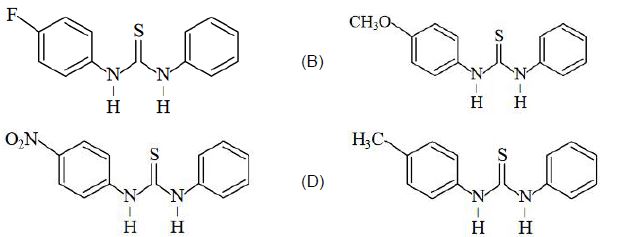
The increasing order of the $pK_b$ of the following compound is
The value of the energy for the first excited state of hydrogen atom will be ............. $\mathrm{eV}$
Which of the following order of resonance energy is correct ?
$H -$ bonding is maximum in
The elements which occupy the peaks of ionisation energy curve, are
The energy of a system available to do work is called as:
Given below are two statements: one is labelled as Assertion $(A)$ and the other is labelled as Reason $(R)$

Assertion $(A) :$ At $10^{\circ} C$, the density of a $5\, M$ solution of $KCl$ [atomic masses of $K$ and $Cl$ are $39$ and $35.5\, g \,mol ^{-1}$ ]. The solution is cooled to $-21^{\circ} C$. The molality of the solution will remain unchanged.

Reason $(R):$ The molality of a solution does not change with temperature as mass remains unaffected with temperature.

In the light of the above statements, choose the correct answer from the options given below

For the reaction : $N_2 (g)$ $+$ $3H_2(g)$ $\rightarrow$ $2NH_3(g)$, $\Delta H =\, -24\,Kcal$ at  $427\,^oC$ and $200\,atm$ . Calculate magnitude of internal energy change (in $Kcal\,\Delta U$), if $168\,gm$ $N_2$ gas and $30 \,gm$ $H_2$ gas are allowed to react completely ( $100\%$ reaction yield) to form $NH_3$ gas at $427\,^oC$ and $200\,atm$......$Kcal$
Assign $A, B, C, D$ from given type of reaction. $3PbS + 8HNO_3\, (Dil.) \longrightarrow 3Pb(NO_3)_2 + 3S  \downarrow  + 2NO + 4H_2O$
Sodium nitroprusside reacts with sodium sulphide formed in lassaigne's test to detect presence of sulphur gives violet colour due to: