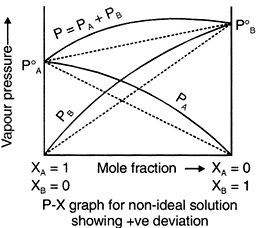
MCQ
The solution which shows negative or positive deviation by Raoult's law, is called
  • A
    Ideal solution
  • B
    Real solution
  • Non-ideal solution
  • D
    Colloidal solution

Answer

Correct option: C.
Non-ideal solution
c
The solutions which don't obey Raoult's law at every range of concentration and at all temperatures are Non-Ideal Solutions. Non-ideal solutions deviate from ideal solutions and are also known as Non-Ideal Solutions.

Need a full question paper?

Generate a complete, print-ready paper with questions like this in minutes — across 16+ boards, with answer keys.

Start Generating Free

Similar questions

Formaldehyde and formic acid can be distinguished using
$0.6$ $mole$ of $NH_3$ in a reaction vessel of $2\,dm^3$ capacity was brought to equilibrium. The vessel was then found to contain $0.15\, mole$ of $H_2$ formed by the reaction $2N{H_{3(g)}} = {N_{2(g)}} + 3{H_{2(g)}}$ Which of the following statements is true
Reactant $A$ of the above reaction is
Which of the following attraction is strongest ?
The correct order of acid strength is
an oxidation-reduction reaction in which $3$ electrons are transferred has a $\Delta G ^{\circ}$ of $17.37\, kJ$ $mol ^{-1}$ at $25^{\circ} C$. The value of $E _{\text {cell }}^{\circ}$ (in $V$ ) is........ $\times 10^{-2}$

$\left(1 F =96,500\, C\, mol ^{-1}\right)$

The pair(s) of coordination complexes/ions exhibiting the same kind of isomerism is(are)

$(A)$ $\left[ Cr \left( NH _3\right)_5 Cl ^2 Cl _2\right.$ and $\left[ Cr \left( NH _3\right)_4 Cl _2\right) Cl$

$(B)$ $\left[ Co \left( NH _3\right)_4 Cl _2\right]^{+}$and $\left[ Pt \left( NH _3\right)_2\left( H _2 O \right) Cl \right]^{+}$

$(C)$ $\left[ CoBr _2 Cl _2\right]^{2-}$ and $\left[ PtBr _2 Cl _2\right]^{2-}$

$(D)$ $\left[ Pt \left( NH _3\right)_3\left( NO _3\right) Cl\right.$ and $\left[ Pt \left( NH _3\right)_3 Cl \right] Br$

An ideal solution has two component $A$ and $B$. If $A$ is more volatile than $B$ then, the correct relation between mole fraction of $A$ in liquid $(X_A)$ and vapour phase $(Y_A)$ is
Which of the following compounds will show the maximum ‘enol’ content?
Increasing order of acid strength of halogen acid is