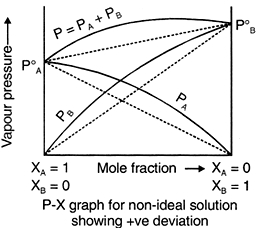
MCQ
The solution which shows negative or positive deviation by Raoult's law, is called
  • A
    Ideal solution
  • B
    Real solution
  • Non-ideal solution
  • D
    Colloidal solution

Answer

Correct option: C.
Non-ideal solution
c
The solutions which don't obey Raoult's law at every range of concentration and at all temperatures are Non-Ideal Solutions. Non-ideal solutions deviate from ideal solutions and are also known as Non-Ideal Solutions.

Need a full question paper?

Generate a complete, print-ready paper with questions like this in minutes — across 16+ boards, with answer keys.

Start Generating Free

Similar questions

Which of the following represent correct reactivity order for $SN^1$ as well as $SN^2$
mechanism -
The emf of a Daniel cell at $ 298\,K$ is ${E_1}$ $Zn|\mathop {ZnS{O_4}}\limits_{(0.01\,M)} ||\mathop {CuS{O_4}}\limits_{(1.0\,M)} |Cu$ when the concentration of $ZnS{O_4}$ is $1.0\,M $ and that of $CuS{O_4}$ is $0.01\,M$, the emf changed to ${E_2}$. What is the relationship between ${E_1}$ and ${E_2}$
In which of the following compounds iron has lowest oxidation state
select correct statement for ideal solution of a non-volatile solute in liquid solvent.
Because of resonance the oxygen atom of $ - OH$ group of phenol
The catalytic activity of the transition metals and their compounds is ascribed to their
Consider the following reactions:

$PCl _{3}+ H _{2} O \longrightarrow A + HCl$

$A + H _{2} O \longrightarrow B + HCl$

number of ionisable protons present in the product $B\,.....$

Fluorine does not form positive oxidation states because
The potential for the given half cell at $298 \mathrm{~K}$ is $(-)$ $(-) \ldots \ldots \ldots . . \times 10^{-2} \mathrm{~V} .$

$2 \mathrm{H}_{(\mathrm{aq})}^{+}+2 \mathrm{e}^{-} \rightarrow \mathrm{H}_2(\mathrm{~g})$

${\left[\mathrm{H}^{+}\right]=1 \mathrm{M}, \mathrm{P}_{\mathrm{H}_2}=2 \mathrm{~atm}}$

(Given: $2.303 \mathrm{RT} / \mathrm{F}=0.06 \mathrm{~V}, \log 2=0.3$ )

The reaction $2 A + B _{2} \rightarrow 2 AB$ is an elementary reaction.

For a certain quantity of reactants, if the volume of the reaction vessel is reduced by a factor of $3,$ the rate of the reaction increases by a factor of $.....$. (Round off to the Nearest Integer).