The space between the plates of a parallel plate capacitor is filled with a 'dielectric' whose 'dielectric constant' varies with distance as per the relation:
$K(x) = K_0 + \lambda x$ ( $\lambda =$ constant)
The capacitance $C,$ of the capacitor, would be related to its vacuum capacitance $C_0$ for the relation
JEE MAIN 2014, Diffcult
Download our app for free and get started
The value of diclectric constant is given as
$\mathrm{K}=\mathrm{K}_{0}+\lambda \mathrm{x}$
And, $\mathrm{V}=\int_{0}^{\mathrm{d}} \mathrm{Edr}$
$\mathrm{v}=\int_{0}^{\mathrm{d}} \frac{\sigma}{\mathrm{K}} \mathrm{dx}$
${=\sigma \int_{0}^{d} \frac{1}{\left(K_{0}+\lambda x\right.} d x}$
${=\frac{\sigma}{\lambda}\left[\ln \left(K_{0}+\lambda d-\ln K_{0}\right]\right.}$
${=\frac{\sigma}{\lambda} \ln \left(1+\frac{\lambda d}{K_{0}}\right)}$
Now it is given that capacitance of vacuum $=1$
Thus, $C=\frac{Q}{V}$
$=\frac{\sigma . s}{v}$ (Let surface area of plates $=$ $s$)
$=\frac{\sigma}{\lambda} \ln \left(1+\frac{\lambda \mathrm{d}}{\mathrm{K}_{0}}\right)$
$ = \operatorname{s} \,\lambda \,\frac{d}{d}\frac{1}{{\ln \left( {1 + \frac{{\lambda d}}{{{K_0}}}} \right)}}\left( {\because {\text{ in vacuum }}{\varepsilon _0} = } \right.$
$c=\frac{\lambda d}{\ln \left(1+\frac{\lambda d}{K_{0}}\right)} \cdot C_{0}\left(\text { here, } C_{0}=\frac{s}{d}\right)$

Download our appand get started for free
Experience the future of education. Simply download our apps or reach out to us for more information. Let's shape the future of learning together!No signup needed.*
Similar Questions
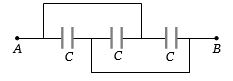
- 1Three equal capacitors, each with capacitance $C$ are connected as shown in figure. Then the equivalent capacitance between $A$ and $B$ isView Solution
- 2Two large vertical and parallel metal plates having a separation of $1 \ cm$ are connected to a $DC$ voltage source of potential difference $X$. A proton is released at rest midway between the two plates. It is found to move at $45^{\circ}$ to the vertical $JUST$ after release. Then $X$ is nearlyView Solution
- 3View SolutionAssertion : The electrostatic force between the plates of a charged isolated capacitor decreases when dielectric fills whole space between plates.
Reason : The electric field between the plates of a charged isolated capacitance increases when dielectric fills whole space between plates.
- 4Assertion : The total charge stored in a capacitor is zero.View Solution
Reason : The field just outside the capacitor is $\frac{\sigma }{{{\varepsilon _0}}}$. ( $\sigma $ is the charge density).
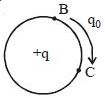
- 5A circle of radius $R$ is drawn with charge $+ q$ at the centre. A charge $q_0$ is brought from point $B$ to $C$, then work done isView Solution
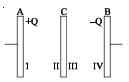
- 6Plates $A$ and $B$ constitute an isolated, charge parallel-plate capacitor. The inner surfaces ($I$ and $IV$) of $A$ and $B$ have charges $+Q$ and $-Q$ respectively. Athird plate $C$ with charge $+$$Q$ is now introduced midway between $A$ and $B$. Which of the following statements is not correct?View Solution
- 7The capacitance of an air filled parallel plate capacitor is $10\,p F$. The separation between the plates is doubled and the space between the plates is then filled with wax giving the capacitance a new value of $40 \times {10^{ - 12}}farads$. The dielectric constant of wax isView Solution
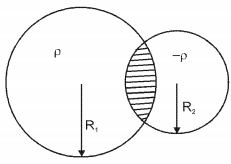
- 8Two non-conducting spheres of radii $R_1$ and $R_2$ and carrying uniform volume charge densities $+\rho$ and $-\rho$, respectively, are placed such that they partially overlap, as shown in the figure. At all points in the overlapping region: $Image$View Solution
$(A)$ the electrostatic field is zero
$(B)$ the electrostatic potential is constant
$(C)$ the electrostatic field is constant in magnitude
$(D)$ the electrostatic field has same direction
- 9View SolutionDielectric constant for metal is
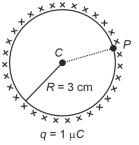
- 10A thin spherical shell is charged by some source. The potential difference between the two points $C$ and $P$ (in $V$) shown in the figure is:View Solution
(Take $\frac{1}{4 \pi \varepsilon_0}=9 \times 10^9$ $SI$ units)