MCQ
The specific heat relation for ideal gas is
  • A
    ${C_P} + {C_V} = R$
  • ${C_P} - {C_V} = R$
  • C
    ${C_P}/{C_V} = R$
  • D
    ${C_V}/{C_P} = R$

Answer

Correct option: B.
${C_P} - {C_V} = R$
b
${C_P} - {C_V} = R = $ universal gas constant

Need a full question paper?

Generate a complete, print-ready paper with questions like this in minutes — across 16+ boards, with answer keys.

Start Generating Free

Similar questions

Newton-second is the unit of
The hour hand of a clock is $6\,cm$ long. The magnitude of the displacement of the tip of hour between $1:00\,PM$ to $5:00\,PM$ is
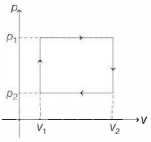
$n$ moles of a van der Waals' gas obeying the equation of state $\left(p+\frac{n^2 a}{V^2}\right)(V-n b)=n R T$, where $a$ and $b$ are gas dependent constants, is made to undergo a cyclic process that is depicted by a rectangle in the $p-V$ diagram as shown below. What is the heat absorbed by the gas in one cycle?
A and B are two wires. The radius of A is twice that of B. They are stretched by the same load. Then, the stress on B is:
Find the approx. number of molecules contained in a vessel of volume $7$ litres at $0^oC$ at $1.3 \times 10^5$ pascal
A liquid is kept in a cylindrical jar, which is rotated about the cylindrical axis. The liquid rises at its ends. The radius of the jar is $r$ and speed of rotation is $\omega$. The difference in height at the centre and the sides of jar is
A heave uniform rod Is hanging vertically form a foxed support. It is stretched by its won weight. The diameter of the rod is.
  1. Smallest at the top and gradually increases down the rod.
  2. Largest at the top and gradually decreased down the rod.
  3. Uniform everywhere.
  4. Maximum in the middle.
The distance travelled by a particle is directly proportional to $t^{1/2}$, where $t =$ time elapsed. What is the nature of motion ?
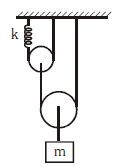
What is the period of small oscillations of the block of mass $m$ if the springs are ideal and pulleys are massless ?
A point moves such that its displacement as a function of time is given by $x^3$ = $t^3 + 1$. Its acceleration as a function of time $t$ will be