MCQ
The speed of electromagnetic radiation in vacuum is
  • A
    ${\mu _0}{ \in _0}$
  • B
    $\sqrt {{\mu _0}{ \in _0}} $
  • C
    $\frac{1}{{{\mu _0}{ \in _0}}}$
  • $\frac{1}{{\sqrt {{\mu _0}{ \in _0}} }}$

Answer

Correct option: D.
$\frac{1}{{\sqrt {{\mu _0}{ \in _0}} }}$
d
Maxwell deduced that the speed of propagation of an electromagnetic wave through a vacuum is entirely determined by the constants $\mu_0$ and $\in_0$ as the following:

$c=\frac{1}{\sqrt{\mu_0 \varepsilon_0}}$

We know that $\mu_0=4 \pi \times 10^{-7}\,Ns ^2 C ^{-2}$ and $\in_0=8.854 \times 10^{-12}\, C ^2\, N ^{-1} \,m ^{-2}$ which gives:

$c =\frac{1}{\sqrt{4 \pi \times 10^{-7} 8.854 \times 10^{-1.12}}}=2.998 \times 10^8\,m / s$

Need a full question paper?

Generate a complete, print-ready paper with questions like this in minutes — across 16+ boards, with answer keys.
Start Generating Free

Similar questions

The capacitor of capacitance 4 μF and 6 μF are connected in series. A potential difference of 500 volts is applied to the outer plates of the two capacitor system. The potential difference across the plates of capacitor of 4 μF capacitance is
White light is passed through a double slit and interference is observed on a screen $1.5 \,{m}$ away. The separation between the slits is $0.3 \,{mm}$. The first violet and red fringes are formed $2.0 \,{mm}$ and $3.5\, {mm}$ away from the central white fringes. The difference in wavelengths of red and voilet light is $.... \,{nm} .$
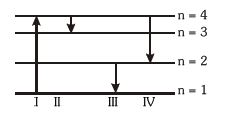
The diagram shown the energy levels for an electron in a certain atom. Which transition shown represents the emission of a photon with the most energy ?
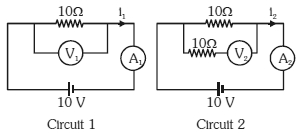
In the circuits shown below, the readings of the voltmeters and the ammeters will be
A sinusoidal voltage $\text{V}=200\sin314\text{t}$ is applied to a $10\Omega$ resistor. Find the peak voltage.
The number of photo electrons emitted for light of a frequency $v ($higher than the threshold frequency $v_0​)$ is proportional to:
$X-$ rays cannot be deflected by means of an ordinary grating due to
The density of a rod gradually decreases from one end to the other. It is pivoted at an end so that it can move about a vertical axis through the pivot. A horizontal force $F$ is applied on the free end in a direction perpendicular to the rod. The quantities, that do not depend on which end of the rod is pivoted, are:
The photoelectric effect can be understood on the basis of
Two resistances $R_1$ and $R_2$ when connected in series and parallel with 120 V line, power consumed will be 25 W and 100 W respectively. Then the ratio of power consumed by $R_1$ to that consumed by $R_2$ will be