MCQ
The speed of sound in oxygen at $S.T.P. $will be approximately:

(Given, $\mathrm{R}=8.3 \mathrm{JK}^{-1}, \gamma=1.4$ )

  • $310 \mathrm{~m} / \mathrm{s}$
  • B
     $333 \mathrm{~m} / \mathrm{s}$
  • C
    $341 \mathrm{~m} / \mathrm{s}$
  • D
     $325 \mathrm{~m} / \mathrm{s}$

Answer

Correct option: A.
$310 \mathrm{~m} / \mathrm{s}$
a
$\mathrm{v}=\sqrt{\frac{\gamma \mathrm{RT}}{\mathrm{M}}}=\sqrt{\frac{1.4 \times 8.3 \times 273}{32 \times 10^{-3}}}$

$=314.8541 \simeq 315 \mathrm{~m} / \mathrm{s}$

Need a full question paper?

Generate a complete, print-ready paper with questions like this in minutes — across 16+ boards, with answer keys.

Start Generating Free

Similar questions

Which of the following equations is dimensionally incorrect?

Where $t=$ time, $h=$ height, $s=$ surface tension, $\theta=$ angle, $\rho=$ density, $a, r=$ radius, $g=$ acceleration due to gravity, ${v}=$ volume, ${p}=$ pressure, ${W}=$ work done, $\Gamma=$ torque, $\varepsilon=$ permittivity, ${E}=$ electric field, ${J}=$ current density, ${L}=$ length.

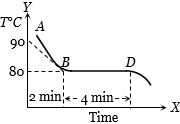
The figure given below shows the cooling curve of pure wax material after heating. It cools from $A$ to $B$ and solidifies along $BD$. If $L$ and $C$ are respective values of latent heat and the specific heat of the liquid wax, the ratio $L/C$ is
On applying a stress of $20 \times 10^8 Nm ^{-2}$, the length of a perfectly elastic wire is doubled. Its Young's modulus will be:
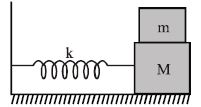
In the arrangement, spring constant $k$ has value $2\,N\,m^{-1}$ , mass $M = 3\,kg$ and mass $m = 1\,kg$ . Mass $M$ is in contact with a smooth surface. The coefficient of friction between two blocks is $0.1$ . The time period of $SHM$ executed by the system is
If $\overrightarrow A = 2\hat i + 4\hat j - 5\hat k$ the direction of cosines of the vector $\overrightarrow A $ are
$second^{-1}$ is unit of 
At what temperature volume of an ideal gas at $0°C$ becomes triple ....... $^oC$
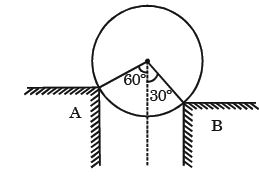
A smooth cylinder of mass $m$ and radius $R$  is resting on two corner edges  $A$  and $B$  as shown in fig. The relation between normal reaction at the edges $A$ and $B$  is
The maximum velocity of a simple harmonic motion represented by $y = 3\sin \,\left( {100\,t + \frac{\pi }{6}} \right)$is given by
One mole of an ideal monoatomic gas is heated at a constant pressure of one atmosphere from ${0^o}C$ to ${100^o}C$. Then the change in the internal energy is