MCQ
Which of the following equations is dimensionally incorrect?

Where $t=$ time, $h=$ height, $s=$ surface tension, $\theta=$ angle, $\rho=$ density, $a, r=$ radius, $g=$ acceleration due to gravity, ${v}=$ volume, ${p}=$ pressure, ${W}=$ work done, $\Gamma=$ torque, $\varepsilon=$ permittivity, ${E}=$ electric field, ${J}=$ current density, ${L}=$ length.

  • ${v}=\frac{\pi {pa}^{4}}{8 \eta {L}}$
  • B
    ${h}=\frac{2 {s} \cos \theta}{\rho {rg}}$
  • C
    ${J}=\varepsilon \frac{\partial {E}}{\partial {t}}$
  • D
    ${W}=\Gamma \theta$

Answer

Correct option: A.
${v}=\frac{\pi {pa}^{4}}{8 \eta {L}}$
a
$(i)$ $\frac{\pi {pa}^{4}}{8 \eta {L}}=\frac{{d} {v}}{{dt}}=$ Volumetric flow rate

(poiseuille's law)

$(ii)$ ${h} \rho {g}=\frac{2 {s}}{{r}} \cos \theta$

$(iii)$ ${RHS} \Rightarrow \varepsilon \times \frac{1}{4 \pi \varepsilon_{0}} \frac{{a}}{{r}^{2}} \times \frac{1}{\varepsilon}=\frac{{q}}{{t}} \times \frac{1}{{r}^{2}}$ $=\frac{{I}}{{L}^{2}}={IL}^{-2}$

$LHS$

${T}=\frac{{I}}{{A}}={IL}^{-2}$

$(iv)$ ${W}=\tau \theta$

Need a full question paper?

Generate a complete, print-ready paper with questions like this in minutes — across 16+ boards, with answer keys.

Start Generating Free

Similar questions

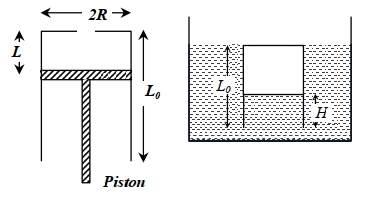
A fixed thermally conducting cylinder has a radius $\mathrm{R}$ and height $\mathrm{L}_0$. The cylinder is open at its bottom and has a small hole at its top. A piston of mass $M$ is held at a distance $L$ from the top surface, as shown in the figure. The atmospheric pressure is $\mathrm{P}_0$.

$1.$  The piston is now pulled out slowly and held at a distance $2 \mathrm{~L}$ from the top. The pressure in the cylinder between its top and the piston will then be

$(A)$ $\mathrm{P}_0$ $(B)$ $\frac{\mathrm{P}_0}{2}$  $(C)$ $\frac{P_0}{2}+\frac{M g}{\pi R^2}$  $(D)$ $\frac{\mathrm{P}_0}{2}-\frac{\mathrm{Mg}}{\pi \mathrm{R}^2}$

$2.$  While the piston is at a distance $2 \mathrm{~L}$ from the top, the hole at the top is sealed. The piston is then released, to a position where it can stay in equilibrium. In this condition, the distance of the piston from the top is

$(A)$ $\left(\frac{2 \mathrm{P}_0 \pi \mathrm{R}^2}{\pi \mathrm{R}^2 \mathrm{P}_0+\mathrm{Mg}}\right)(2 \mathrm{~L})$  $(B)$ $\left(\frac{\mathrm{P}_0 \pi R^2-\mathrm{Mg}}{\pi R^2 \mathrm{P}_0}\right)(2 \mathrm{~L})$ 

$(C)$ $\left(\frac{\mathrm{P}_0 \pi \mathrm{R}^2+\mathrm{Mg}}{\pi \mathrm{R}^2 \mathrm{P}_0}\right)(2 \mathrm{~L})$  $(D)$ $\left(\frac{\mathrm{P}_0 \pi \mathrm{R}^2}{\pi \mathrm{R}^2 \mathrm{P}_0-\mathrm{Mg}}\right)(2 \mathrm{~L})$

$3.$  The piston is taken completely out of the cylinder. The hole at the top is sealed. A water tank is brought below the cylinder and put in a position so that the water surface in the tank is at the same level as the top of the cylinder as shown in the figure. The density of the water is $\rho$. In equilibrium, the height $\mathrm{H}$ of the water column in the cylinder satisfies

$(A)$ $\rho g\left(\mathrm{~L}_0-\mathrm{H}\right)^2+\mathrm{P}_0\left(\mathrm{~L}_0-\mathrm{H}\right)+\mathrm{L}_0 \mathrm{P}_0=0$

$(B)$ $\rho \mathrm{g}\left(\mathrm{L}_0-\mathrm{H}\right)^2-\mathrm{P}_0\left(\mathrm{~L}_0-\mathrm{H}\right)-\mathrm{L}_0 \mathrm{P}_0=0$

$(C)$ $\rho g\left(\mathrm{~L}_0-\mathrm{H}\right)^2+\mathrm{P}_0\left(\mathrm{~L}_0-\mathrm{H}\right)-\mathrm{L}_0 \mathrm{P}_0=0$

$(D)$ $\rho \mathrm{g}\left(\mathrm{L}_0-\mathrm{H}\right)^2-\mathrm{P}_0\left(\mathrm{~L}_0-\mathrm{H}\right)+\mathrm{L}_0 \mathrm{P}_0=0$

Give the answer question $1,2$ and $3.$
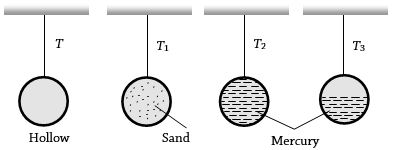
The period of a simple pendulum, whose bob is a hollow metallic sphere, is $T$.The period is $T_1$ when the bob is filled with sand, $T_2$ when it is filled with mercury and $T_3$ when it is half filled with mercury. Which of the following is true
Two rectangular blocks $A$ and $B$ of different metals have same length and same area of cross-section. They are kept in such a way that their cross-sectional area touch each other. The temperature at one end of $A$ is $100°C$ and that of $B$ at the other end is $0°C$ . If the ratio of their thermal conductivity is $1 : 3$ , then under steady state, the temperature of the junction in contact will be ........ $^oC$
The equation of displacement of two waves are given as ${y_1} = 10\sin \left( {3\pi t + \frac{\pi }{3}} \right)$; ${y_2} = 5(\sin 3\pi t + \sqrt 3 \cos 3\pi t)$. Then what is the ratio of their amplitudes
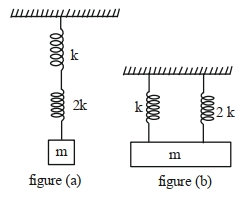
As per given figures, two springs of spring constants $K$ and $2\,K$ are connected to mass $m$. If the period of oscillation in figure $(a)$ is $3 s$, then the period of oscillation in figure $(b)$ will be $\sqrt{ x }$ s. The value of $x$ is$.........$
The trajectory of an object is defined as $x = (t - 4)^2$, what is the velocity at $t = 5?$
The position of a particle moving in the $xy-$plane at any time $t$ is given by $x = (3{t^2} - 6t)$ metres, $y = ({t^2} - 2t)$ metres. Select the correct statement about the moving particle from the following
The maximum vertical height to which a man can throw a ball is $136\,m$. The maximum horizontal distance upto which he can throw the same ball is $.....\,m$
A piece of glass is heated to a high temperature and then allowed to cool. If it cracks, a probable reason for this is the following property of glass
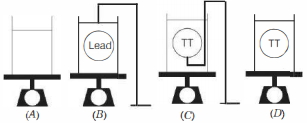
Four identical beakers contain same amount of water as shown below. Beaker $A$ contains only water. A lead ball is held submerged in the beaker $B$ by string from above. A same sized plastic ball, say a table tennis $(TT)$ ball, is held submerged in beaker $C$ by a string attached to a stand from outside. Beaker $D$ contains same sized $TT$ ball which is held submerged from a string attached to the bottom of the beaker. These beakers (without stand) are placed on weighing pans and register readings $w_{A}, w_{B}, w_{C}$ and $w_{D}$ for $A, B, C$ and $D$, respectively. Effects of the mass and volume of the stand and string are to be neglected.