MCQ
The standard electrode potential for $Cu^{+2}/Cu$ is $0.34\, volt$ calculate the reduction potential at $pH = 14$ for the above couple ............... $\mathrm{V}$ $[K_{sp}[Cu(OH)_2) = 1 \times 10^{-19}]$
- A$+0.03$
- B$-3.09$
- ✓$-0.22$
- D$1.50$
$E=E^{\circ}-\frac{0.06}{2} \log \frac{1}{\left(\mathbf{C u}^{+2}\right)}$
$\mathrm{Cu}(\mathrm{OH})_{2} \rightleftharpoons \mathrm{Cu}^{+2}+2 \mathrm{OH}^{-}$
$\mathrm{k}_{\mathrm{sp}}=\left(\mathrm{Cu}^{+2}\right)\left(\mathrm{OH}^{-}\right)^{2}$
$10^{-19}=\left(\mathrm{Cu}^{+2}\right)(1)^{2}$
$\left( {{\text{C}}{{\text{u}}^{ + 2}}} \right) = {10^{ - 19}}$ ${{\text{P}}^{\text{H}}} = 14$
${\mathrm{P}^{\mathrm{OH}}=0}$
${\mathrm{OH}^{-} \Rightarrow 1}$
solve it
${E}=-\,0.22\, \mathrm{V}$
Generate a complete, print-ready paper with questions like this in minutes — across 16+ boards, with answer keys.
Assume $100 \%$ ionization for both $NaCl$ and $MgCl _2$
Given : $K _{ b }\left( H _2 O \right)=0.52\,K\,kg\,mol ^{-1}$
Molar mass of $NaCl$ and $MgCl _2$ is 58.5 and $95\,g$ $mol ^{-1}$ respectively.
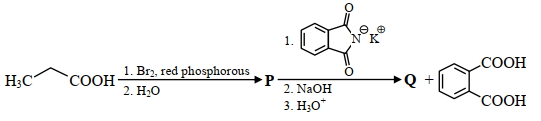
$(A)$ $P$ can be reduced to a primary alcohol using $NaBH _4$.
$(B)$ Treating $P$ with conc. $NH _4 OH$ solution followed by acidification gives $Q$.
$(C)$ Treating $Q$ with a solution of $NaNO _2$ in aq. $HCl$ liberates $N _2$.
$(D)$ $P$ is more acidic than $CH _3 CH _2 COOH$.