MCQ
The standard electrode potentials

${E^o}_{\left( {{I_2}/{I^ - }} \right)},{E^ \circ }_{\left( {Br^-/B{r_2}} \right)}$ and ${E^ o }_{\left( {{Fe}/{Fe^{2+} }} \right)}$

are respectively $+ 0.54\  V$, $-1.09\  V$ and $0.44\  V$. On the basis of above data which of the following process is non-spontaneous

  • A
    $B{r_2} + 2{I^ - } \to 2B{r^ - } + {I_2}$
  • B
    $Fe + B{r_2} \to F{e^{2 + }} + 2B{r^ - }$
  • C
    $Fe + {I_2} \to F{e^{2 + }} + 2{I^ - }$
  • ${I_2} + 2B{r^ - } \to 2{I^ - } + B{r_2}$
Answer

Correct option: D.
${I_2} + 2B{r^ - } \to 2{I^ - } + B{r_2}$
d
For   ${{\text{I}}_{2}}+2\text{B}{{\text{r}}^{-}}\to 2{{I}^{-}}+\text{B}{{\text{r}}_{2}}$

$\text{E}_{\text{cell }}^{o}=\left( \text{E}_{\text{Rp}}^{{}^o } \right)\text{ cathode }-{{\left( \text{E}_{\text{RP}}^{{}^o } \right)}_{\text{anode }}}$

$\because \,\,\,\text{E}_{\text{cell}}^{o}$ is negative hence this reaction is non-spontaneous

Need a full question paper?

Generate a complete, print-ready paper with questions like this in minutes — across 16+ boards, with answer keys.

Start Generating Free

Similar questions

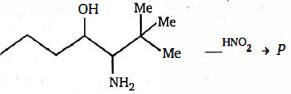
Predict the major product $P$ in the following reaction.
Bond dissociation enthalpy of $E-H (E =$ element$)$ bonds is given below. Which of the compounds will act as strongest reducing agent?
Compound $\ce{NH_3}$ $\ce{PH_3}$ $\ce{AsH_3}$ $\ce{SbH_3}$
$\Delta_{\text{diss}}(\text{E}-\text{H})/\text{kJ mol}^{-1}$ $389$ $322$ $297$ $255$
In an electroplating experiment, $m \,gm$ of silver is deposited when $4\, ampere$ of current flows for $2$ minute. The amount (in $gm$) of silver deposited by $6\, ampere$ of current for $40$ second will be
$100\ ml$ , $1\,M\ H_2SO_4$ solution of density $1.5\ gm/ml$ is mixed with $400\ ml$ of water, resulting in a diluted solution of density $1.25\ gm/ml$ Find molarity of final diluted solution.

(Density of water $= 1\,gm/ml$ )

Given 

$F{e^{ + 3}}\left( {aq} \right) + {e^ - } \to F{e^{2 + }}\left( {aq} \right);{E^o} =  + 0.77\,V$

$A{l^{ + 3}}\left( {aq} \right) + 3{e^ - } \to Al\left( s \right);{E^o} =  - 1.66\,V$

$B{r_2}\left( {aq} \right) + 2{e^ - } \to 2B{r^ - };{E^o} =  + 1.09\,V$

Considering the electrode potentials, which of the following represents the correct order of reducing power?

A compound $X $ on reaction with chloroform and  $NaOH$  gives a compound with a very unpleasant odour. $X$  is
Which statement is wrong regarding osmotic pressure $(P), $ volume $  (V)$  and temperature $  (T)$
First compound of inert gases was prepared by scientist Neil Barthlete in $1962.$ This compound is
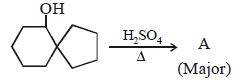
Major product $A$ is 
A $1.84\,mg$ sample of polyhydric alcoholic compound ' $X$ ' of molar mass $92.0\,g / mol$ gave $1.344\,mL$ of $H _{2}$ gas at $STP$. The number of alcoholic hydrogens present in compound ' $X$ ' is $.....$