Question
The stopping potential $({V_0})$

Answer

(d) Stopping potential depends upon the energy of photon

Need a full question paper?

Generate a complete, print-ready paper with questions like this in minutes — across 16+ boards, with answer keys.

Start Generating Free

Similar questions

Two bulbs of equal wattage, one having carbon filament and the other having a tungsten filament are connected in series to the mains, then
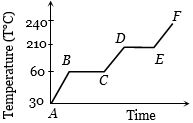
A solid substance is at $30°C$. To this substance heat energy is supplied at a constant rate. Then temperature versus time graph is as shown in the figure. The substance is in liquid state for the portion (of the graph)
$A$ light of wavelength $6300Å$ shine on a two narrow slits separated by a distance $1.0\, mm$ and illuminates a screen at $a$ distance $1.5\, m$ away. When one slit is covered by a thin glass of refractive index $1.8$ and other slit by a thin glass plate of refractive index $\mu$ , the central maxima shifts by $6^o$. Both plates have same thickness of $0.5\, mm$. The value of refractive index $\mu$ of the plate is
The example of nuclear fusion is
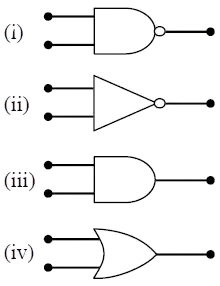
The symbolic representation of four logic gates are given below

The logic symbols for $OR, NOT$ and $NAND$ gates are respectively 
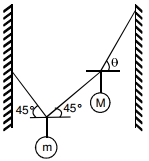
Two masses $m$ and $M$ are attached to the strings as shown in the figure. If the system is in equilibrium, then
A parallel plate condenser is immersed in an oil of dielectric constant $2$. The field between the plates is
A train whistling at constant frequency is moving towards a station at a constant speed $V$ . The train goes past a stationary observer on the station. The frequency $n'$ of the sound as heard by the observer is plotted as a function of time $t$ (Fig.) . Identify the expected curve
Which of the following transition will have highest emission wavelength
A body $A$ is projected upwards with a velocity of $98\,m/s$. The second body $B$ is projected upwards with the same initial velocity but after $4 \,sec$. Both the bodies will meet after...........$sec$