A parallel plate condenser is immersed in an oil of dielectric constant $2$. The field between the plates is
Easy


Download our appand get started for free
Experience the future of education. Simply download our apps or reach out to us for more information. Let's shape the future of learning together!No signup needed.*
Similar Questions
- 1Three infinitely long linear charges of charge density $\lambda $ , $\lambda $ and $-2\lambda $ are placed in space. A point in space is specified by its perpendicular distance $r_1 , r_2 $ and $ r_3$ respectively from the linear charges. For the points which are equipotentialView Solution
- 2Two insulating plates are both uniformly charged in such a way that the potential difference between them is $V_2 - V_1 = 20\ V$. (i.e., plate $2$ is at a higher potential). The plates are separated by $d = 0.1\ m$ and can be treated as infinitely large. An electron is released from rest on the inner surface of plate $1. $ What is its speed when it hits plate $2?$View Solution
$(e = 1.6 \times 10^{-19}\ C, m_e= 9.11 \times 10^{-31}\ kg)$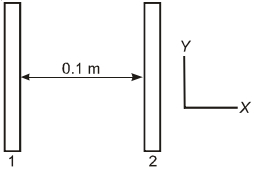
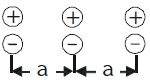
- 3Three identical small electric dipoles are arranged parallel to each other at equal separation a as shown in the figure. Their total interaction energy is $U$. Now one of the end dipole is gradually reversed, how much work is done by the electric forces.View Solution
- 4A dipole consisting of two charge $\pm q$ separated by a distance $2 a$ is placed with its centre $D$ away from the center of a grounded sphere of radius $R ( D > > a )$. When the dipole moment vector is perpendicular to the line joining the two centres (those of the dipole and sphere) the charge induced on the sphere isView Solution
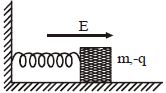
- 5A block of mass $m$ containing a net negative charge $-q$ is placed on a frictionless horizontal table and is connected to a wall through an unstretched spring of spring constant $k$ as shown. If horizontal electric field $E$ parallel to the spring is switched on, then the maximum compression of the spring is :-View Solution
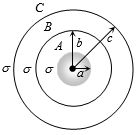
- 6Three concentric metallic shells $A, B$ and $C$ of radii $a, b$ and $c (a < b < c)$ have surface charge densities $\sigma ,\, - \sigma $ and $\sigma $ respectively. then ${V_A}$ and ${V_B}$View Solution
- 7View SolutionThe capacitance of a parallel plate condenser does not depend on
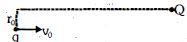
- 8A point chargr $Q$ is fixed A small charge $q$ and mass $m$ is given a velocity $v_0$ from infinity & perpendicular distance $r_0$ as shown. If distance of closest approach is $r_0/2$. The value of $q$ is [Given $mv_0^2 = \frac{{{Q^2}}}{{4\pi { \in _0}\,{r_0}}}$]View Solution
- 9The mean free path of electrons in a metal is $4 \times 10^{-8} \;m$. The electric field which can give on an average $2 \;eV$ energy to an electron in the metal will be in units of $V / m$View Solution
- 10View SolutionA parallel plate capacitor is charged to a certain potential and the charging battery is then disconnected. Now, if the plates of the capacitor are moved apart then: