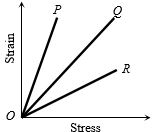
The strain-stress curves of three wires of different materials are shown in the figure. $P, Q$ and $R$ are the elastic limits of the wires. The figure shows that
Medium


Download our appand get started for free
Experience the future of education. Simply download our apps or reach out to us for more information. Let's shape the future of learning together!No signup needed.*
Similar Questions
- 1View SolutionThe material which practically does not show elastic after effect is
- 2A wire of length $50\, cm$ and cross sectional area of $1$ sq. mm is extended by $1\, mm.$ The required work will be $(Y = 2 \times {10^{10}}\,N{m^{ - 2}})$View Solution
- 3A solid sphere of radius $R$ made of of material of bulk modulus $K$ is surrounded by a liquid in a cylindrical container. $A$ massless piston of area $A$ floats on the surface of the liquid. When a mass $m$ is placed on the piston to compress the liquid, the fractional change in the radius of the sphere $\delta R/R$ isView Solution
- 4The mass and length of a wire are $M$ and $L$ respectively. The density of the material of the wire is $d$. On applying the force $F$ on the wire, the increase in length is $l$, then the Young's modulus of the material of the wire will beView Solution
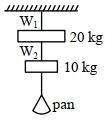
- 5Wires ${W}_{1}$ and ${W}_{2}$ are made of same material having the breaking stress of $1.25 \times 10^{9} \,{N} / {m}^{2}$ ${W}_{1}$ and ${W}_{2}$ have cross-sectional area of $8 \times 10^{-7}\, {m}^{2}$ and $4 \times 10^{-7}\, {m}^{2}$, respectively. Masses of $20 \,{kg}$ and $10\, {kg}$ hang from them as shown in the figure. The maximum mass that can be placed in the pan without breaking the wires is $.....{kg}$ (Use $\left.{g}=10\, {m} / {s}^{2}\right)$View Solution
- 6An Indian rubber cord $L$ metre long and area of cross-section $A$ $metr{e^2}$ is suspended vertically. Density of rubber is $D$ $kg/metr{e^3}$ and Young's modulus of rubber is $E$ $newton/metr{e^2}$. If the wire extends by $l$ metre under its own weight, then extension $l$ isView Solution
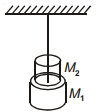
- 7The length of wire, when $M_1$ is hung from it, is $I_1$ and is $I_2$ with both $M_1$ and $M_2$ hanging. The natural length of wire is ........View Solution
- 8If $Y, K$ and $\eta$ are the values of Young's modulus, bulk modulus and modulus of rigidity of any material respectively. Choose the correct relation for these parameters.View Solution
- 9Work done by restoring force in a string within elastic limit is $-10 \,J$. Maximum amount of heat produced in the string is .......... $J$View Solution
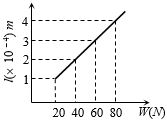
- 10The adjacent graph shows the extension $(\Delta l)$ of a wire of length $1m$ suspended from the top of a roof at one end with a load $W$ connected to the other end. If the cross sectional area of the wire is ${10^{ - 6}}{m^2},$ calculate the young’s modulus of the material of the wireView Solution