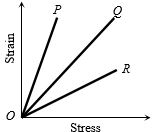
The strain-stress curves of three wires of different materials are shown in the figure. $P, Q$ and $R$ are the elastic limits of the wires. The figure shows that
Medium
Download our app for free and get started
(d) As stress is shown on $x-$axis and strain on $y-$axis
So we can say that $Y = \cot \theta = \frac{1}{{\tan \theta }} = \frac{1}{{{\rm{slope}}}}$
So elasticity of wire $P$ is minimum and of wire $R$ is maximum

Download our appand get started for free
Experience the future of education. Simply download our apps or reach out to us for more information. Let's shape the future of learning together!No signup needed.*
Similar Questions
- 1A cube of aluminium of sides $0.1\, m$ is subjected to a shearing force of $100\, N$. The top face of the cube is displaced through $0.02 \,cm$ with respect to the bottom face. The shearing strain would beView Solution
- 2A glass slab is subjected to a pressure of $10\, atm$. The fractional change in its volume is (Bulk modulus of glass $= 37 \times 10^9\, N\, m^{-2}$, $1\, atm = 1 \times 10^5\, N\, m^{-2}$)View Solution
- 3The Young's modulus of a wire is $y$. If the energy per unit volume is $E$, then the strain will beView Solution
- 4A metal wire of length $0.5 m$ and cross-sectional area $10^{-4}\; m ^{2}$ has breaking stress $5 \times 10^{8}\; Nm ^{-2}$. A block of $10\; kg$ is attached at one end of the string and is rotating in a horizontal circle. The maximum linear velocity of block will be $ms ^{-1}$.View Solution
- 5View SolutionTwo identical wires of rubber and iron are stretched by the same weight, then the number of atoms in the iron wire will be
- 6An $8\,m$ long copper wire and $4\,m$ long steel wire, each of cross section $0.5\,cm^2$ are fastened end to end and stretched by $500\,N$ force. The elastic potential energy of the system is (Youngs mod $: Y_{cu}= 1\times 10^{11}\,N/m^2,$ $Y_{steel} = 2\times 10^{11}\,N/m^2$ ) :View Solution
- 7The bulk modulus of a spherical object is '$B$'. If it is subjected to uniform pressure '$P$', the fractional decrease in radius isView Solution
- 8View SolutionTo keep constant time, watches are fitted with balance wheel made of
- 9When a pressure of $100$ atmosphere is applied on a spherical ball, then its volume reduces to $0.01\%$. The bulk modulus of the material of the rubber in $dyne/c{m^2}$ isView Solution
- 10A wire of area of cross-section $10^{-6}\,m^2$ is increased in length by $0.1\%$. The tension produced is $1000\, N$. The Young's modulus of wire isView Solution