A wire of area of cross-section $10^{-6}\,m^2$ is increased in length by $0.1\%$. The tension produced is $1000\, N$. The Young's modulus of wire is
Easy


Download our appand get started for free
Experience the future of education. Simply download our apps or reach out to us for more information. Let's shape the future of learning together!No signup needed.*
Similar Questions
- 1Young's modules of material of a wire of length ' $L$ ' and cross-sectional area $A$ is $Y$. If the length of the wire is doubled and cross-sectional area is halved then Young's $modules$ will be :View Solution
- 2A composite rod made up of two rods $AB$ and $BC$ are joined at $B$ . The rods are of equal length at room temperature and have equal masses. The coefficient of linear expansion a of $AB$ is more than that of $BC$. The composite rod is suspended horizontal by means of a thread at $B$. When the rod is heatedView Solution
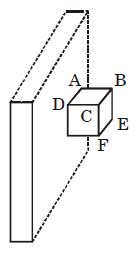
- 3A steel rod is projecting out of rigid wall. The shearing strength of steel is $345 \,\,MN/m^2.$ The dimensions $AB = 5\,\, cm,\,BC = BE = 2\,\, cm.$ The maximum load that can be put on the face $ABCD$ is .......... $kg$ (neglect bending of the rod) $(g = 10\,\, m/s^2)$View Solution
- 4A wire of length $50\, cm$ and cross sectional area of $1$ sq. mm is extended by $1\, mm.$ The required work will be $(Y = 2 \times {10^{10}}\,N{m^{ - 2}})$View Solution
- 5Two similar wires under the same load yield elongation of $0.1$ $mm$ and $0.05$ $mm$ respectively. If the area of cross- section of the first wire is $4m{m^2},$ then the area of cross section of the second wire is..... $mm^2$View Solution
- 6A wire suspended vertically from one end is stretched by attaching a weight $200 \,N$ to the lower end. The weight stretches the wire by $1 \,mm$. The elastic potential energy gained by the wire is ....... $J$View Solution
- 7A steel wire is $1 \,m$ long and $1 \,mm ^2$ in area of cross-section. If it takes $200 \,N$ to stretch this wire by $1 \,mm$, how much force will be required to stretch a wire of the same material as well as diameter from its normal length of $10 \,m$ to a length of $1002 \,cm$ is ........ $N$View Solution
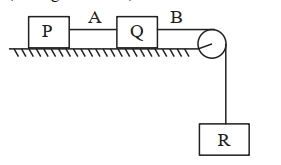
- 8Each of three blocks $P$, $Q$ and $R$ shown in figure has a mass of $3 \mathrm{~kg}$. Each of the wire $A$ and $B$ has cross-sectional area $0.005 \mathrm{~cm}^2$ and Young's modulus $2 \times 10^{11} \mathrm{~N} \mathrm{~m}^{-2}$. Neglecting friction, the longitudinal strain on wire $B$ is____________ $\times 10^{-4}$. $\left(\right.$ Take $\mathrm{g}=10 \mathrm{~m} / \mathrm{s}^2$ )View Solution
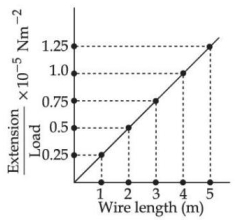
- 9In an experiment to determine the Young's modulus, steel wires of five different lengths $(1,2,3,4$ and $5\,m )$ but of same cross section $\left(2\,mm ^{2}\right)$ were taken and curves between extension and load were obtained. The slope (extension/load) of the curves were plotted with the wire length and the following graph is obtained. If the Young's modulus of given steel wires is $x \times 10^{11}\,Nm ^{-2}$, then the value of $x$ isView Solution
- 10A steel wire can sustain $100\,kg$ weight without breaking. If the wire is cut into two equal parts, each part can sustain a weight of ......... $kg$View Solution