MCQ
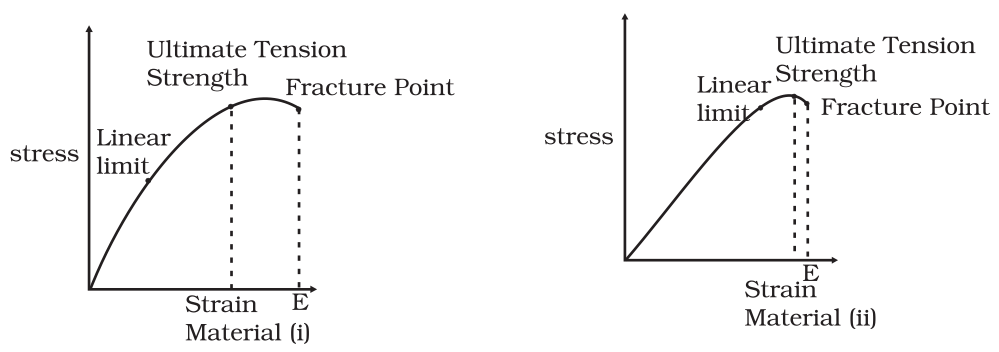
The stress - strain graphs for two materials are shown in (assume same scale).
  • A
    Material (ii) is more elastic than material (i) and hence material (ii) is more brittle.
  • B
    Material (i) and (ii) have the same elasticity and the same brittleness.
  • C
    Material (ii) is elastic over a larger region of strain as compared to (i).
  • D
    Material (ii) is more brittle than material (i).
Answer

  1. Material (ii) is elastic over a larger region of strain as compared to (i).
  2. Material (ii) is more brittle than material (i).
Explanation:

On comparing ultimate tensile strength of the materials, (ii) is greater than (i). Hence, material (ii) is elastic over larger region as compare to (i) so the material (ii) is elastic over a larger region of strain as compared to (i) (verifies option c).

As the fracture point of material (ii) is nearer than (i), hence the material (ii) is more brittle than material (i).
Need a full question paper?

Generate a complete, print-ready paper with questions like this in minutes — across 16+ boards, with answer keys.

Start Generating Free

Similar questions

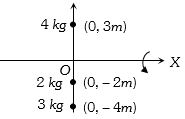
Three particles are situated on a light and rigid rod along $Y$axis as shown in the figure. If the system is rotating with an angular velocity of $2\,rad/\sec $about $X$axis, then the total kinetic energy of the system is ...... $J$
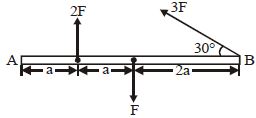
Three forces $F,\,2F$ and $3F$ act on a rod $AB$ which is pivoted at $A$. The anticlockwise moment of forces $F,\,2F$ and $3F$ about the pivot are respectively
$\vec A$ and $\vec B$ are two vectors and $\theta$ is the angle between them, if $|\vec A \times \vec B|=\sqrt 3(\vec A \cdot \vec B) $ the value of $\theta$ is ......... $^o$
A bullet is shot vertically downwards with an initial velocity of $100\,m / s$ from a certain height. Within $10\,s$, the bullet reaches the ground and instantaneously comes to rest due to the perfectly inelastic collision. The velocity-time curve for total time $t =20\,s$ will be. $\left(\right.$ Take $g =10 m / s ^{2}$ )
Two point masses $A$ and $B$ having masses in the ratio $4 : 3$ are separated by a  distance of $1\, m$. When another point $mass\, C$ of $mass\, M$ is placed in  between $A$ and $B$, the force between $A$ and $C$ is ${\left( {\frac{1}{3}} \right)^{rd}}$ of the  force between $B$ and $C$. Then the distance of $C$ from $A$ is
The height $h$ of the liquid column in a capillary tube on Earth is $h$. On the Moon, where the acceleration due to gravity of earth is $1/6.$ This height is :
When an object is shot from the bottom of a long smooth inclined plane kept at an angle $60^{\circ}$ with horizontal. it can travel a distance $\mathrm{x}_{1}$ along the plane. But when the inclination is decreased to $30^{\circ}$ and the same object the shot with the same velocity, it can travel $x_{2}$ distance. Then $x_{1}: x_{2}$ will be
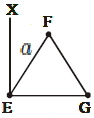
An massless equilateral triangle $EFG$ of side $'a'$ (As shown in figure) has three particles of mass $m$ situated at its vertices. The moment of intertia of the system about the line $EX$ perpendicular to $EG$ in the plane of $EFG$ is $\frac{ N }{20}\, ma ^{2}$ where $N$ is an integer. The value of $N$ is
The vectors $5i + 8j$ and $2i + 7j$ are added. The magnitude of the sum of these vector is
On a horizontal smooth surface a disc is placed at rest. Another disc of same mass is coming with impact parameter equal to its own radius. First disc is of radius $r$. What should be the radius of coming disc so that after collision first disc moves at an angle $45^o$ to the direction of motion of incoming disc :