The following four wires are made of the same material. Which of these will have the largest extension when the same tension is applied?
AIPMT 2013, Medium
Download our app for free and get started
Young's modulus,
$Y = \frac{{FL}}{{A\Delta L}} = \frac{{4FL}}{{\pi {D^2}\Delta L}}\,\,or\,\,\Delta L = \frac{{4FL}}{{\pi {D^2}Y}}$
Where $F$ is the force applied, $L$ is the length, $D$ is the diameter and $\Delta L$ is the extension of the wire respectively.
As each wire is made up of same material therefore their $Young's$ modulus is same for each wire.
Foe all the four wires, $Y,F\,(=tension)$ are the same.
$\therefore \Delta L \propto \frac{L}{{{D^2}}}$
$In\,\,\left( a \right)\,\,\frac{L}{{{D^2}}} = \frac{{200\,cm}}{{{{\left( {0.2\,cm} \right)}^2}}} = 5 \times {10^3}\,c{m^{ - 1}}$
$In\,\,\left( b \right)\,\,\,\frac{L}{{{D^2}}} = \frac{{300\,cm}}{{{{\left( {0.3\,cm} \right)}^2}}} = 3.3 \times {10^3}\,c{m^{ - 1}}$
$In\,\,\left( c \right)\,\,\frac{L}{{{D^2}}} = \frac{{50\,cm}}{{{{\left( {0.05\,cm} \right)}^2}}} = 20 \times {10^3}\,c{m^{ - 1}}$
$In\,\,\left( d \right)\,\,\frac{L}{{{D^2}}} = \frac{{100\,cm}}{{{{\left( {0.1\,cm} \right)}^2}}} = 10 \times {10^3}\,\,c{m^{ - 1}}$

Download our appand get started for free
Experience the future of education. Simply download our apps or reach out to us for more information. Let's shape the future of learning together!No signup needed.*
Similar Questions
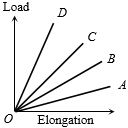
- 1View SolutionThe load versus elongation graph for four wires of the same material is shown in the figure. The thickest wire is represented by the line
- 2A material has Poisson's ratio $0.50.$ If a uniform rod of it suffers a longitudinal strain of $2 \times {10^{ - 3}}$, then the percentage change in volume isView Solution
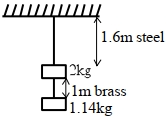
- 3Two wires each of radius $0.2\,cm$ and negligible mass, one made of steel and other made of brass are loaded as shown in the figure. The elongation of the steel wire is $.........\times 10^{-6}\,m$. [Young's modulus for steel $=2 \times 10^{11}\,Nm ^{-2}$ and $g =10\,ms ^{-2}$ ]View Solution
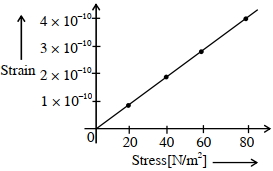
- 4The elastic behaviour of material for linear streass and linear strain, is shown in the figure. The energy density for a linear strain of $5 \times 10^{-4}$ is $\dots \; kJ / m ^{3}$. Assume that material is elastic upto the linear strain of $5 \times 10^{-4}$.View Solution
- 5A wire can be broken by applying a load of $20\, kg$ weight. The force required to break the wire of twice the diameter is .......... $kg\, wt$View Solution
- 6Given below are two statements: one is labelled as Assertion$(A)$ and the other is labelled as Reason $(R).$View Solution
$Assertion$ $(A)$ : In Vernier calliper if positive zero error exists, then while taking measurements, the reading taken will be more than the actual reading.
$Reason$ $(R)$ : The zero error in Vernier Calliper might have happened due to manufacturing defect or due to rough handling.
In the light of the above statements, choose the correct answer from the options given below :
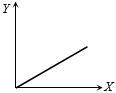
- 7A student plots a graph from his reading on the determination of Young’s modulus of a metal wire but forgets to label. The quantities on $X$ and $Y$ axes may be respectively.View Solution
- 8The breaking stress of wire going over a smooth pully is $2 \times 10^9\, N/m^2$. What would be the minimum radius of wire used if it is not to break?View Solution
- 9The Young's modulus of a wire is $y$. If the energy per unit volume is $E$, then the strain will beView Solution
- 10A wire of length $L$ and radius $r$ is rigidly fixed at one end. On stretching the other end of the wire with a force $F$, the increase in its length is $l$. If another wire of same material but of length $2L$ and radius $2r$ is stretched with a force of $2F$, the increase in its length will beView Solution