MCQ
The strongest Bronsted base in the following anion is
- ✓$Cl{O^ - }$
- B$ClO_2^ - $
- C$ClO_3^ - $
- D$ClO_4^ - $
Generate a complete, print-ready paper with questions like this in minutes — across 16+ boards, with answer keys.
$\begin{array}{*{20}{c}}
{\,\,C{H_3}\,\,\,\,\,\,\,\,\,\,\,\,\,\,\,\,\,C{H_3}} \\
{|\,\,\,\,\,\,\,\,\,\,\,\,\,\,\,\,\,\,\,\,\,\,\,\,\,\,\,\,\,|\,\,} \\
{C{H_3} - CH - CH - CH - C{H_3}} \\
{\,|\,\,\,} \\
{\,\,\,\,\,\,\,\,\,\,\,\,\,\,\,\,\,\,\,\,\,\,C{H_2} - C{H_3}\,\,\,\,\,\,}
\end{array}$
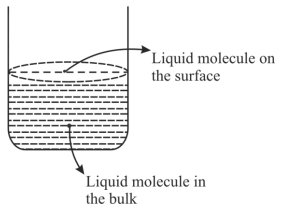
$A.$ Surface tension is the outcome of equal attractive and repulsion forces acting on the liquid molecule in bulk.
$B.$ Surface tension is due to uneven forces acting on the molecules present on the surface.
$C.$ The molecule in the bulk can never come to the liquid surface.
$D.$ The molecules on the surface are responsible for vapour pressure if the system is a closed system.