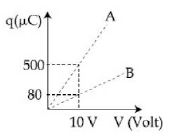
The substances having very short plastic region are
Easy
Download our app for free and get started
(b)
Substances with short plastic region are brittle because less amount of permanent deformation could be done in them.
Download our app
and get started for free
Experience the future of education. Simply download our apps or reach out to us for more information. Let's shape the future of learning together!No signup needed.*
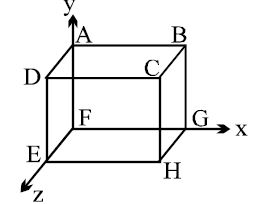
As shown in the figure, forces of $10^5\,N$ each are applied in opposite directions, on the upper and lower faces of a cube of side $10\,cm$, shifting the upper face parallel to itself by $0.5\,cm$ . If the side of another cube of the same material is, $20\,cm$ then under similar conditions as above, the displacement will be......... $cm$
Two blocks of mass $2 \mathrm{~kg}$ and $4 \mathrm{~kg}$ are connected by a metal wire going over a smooth pulley as shown in figure. The radius of wire is $4.0 \times 10^{-5}$ $\mathrm{m}$ and Young's modulus of the metal is $2.0 \times 10^{11} \mathrm{~N} / \mathrm{m}^2$. The longitudinal strain developed in the wire is $\frac{1}{\alpha \pi}$. The value of $\alpha$ is [Use $\mathrm{g}=10 \mathrm{~m} / \mathrm{s}^2$ )
Two wires are made of the same material and have the same volume. However wire $1$ has crosssectional area $A$ and wire $2$ has cross-section area $3A$. If the length of wire $1$ increases by $\Delta x$ on applying force $F$, how much force is needed to stretch wire $2$ by the same amount?
When a force is applied on a wire of uniform cross-sectional area $3 \times {10^{ - 6}}\,{m^2}$ and length $4m$, the increase in length is $1\, mm.$ Energy stored in it will be $(Y = 2 \times {10^{11}}\,N/{m^2})$
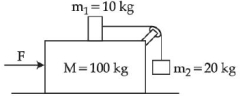
Consider the situation shown in figure. The force $F$ is equal to the $m_2g/2.$ If the area of cross-section of the string is $A$ and its Young's modulus $Y$, find the strain developed in it. The string is light and there is no friction anywhere
Two steel wires of same length but radii $r$ and $2r$ are connected together end to end and tied to a wall as shown. The force stretches the combination by $10\ mm$ . How far does the midpoint $A$ move ......... $mm$