The following four wires are made of same material. Which one will have the largest elongation when subjected to the same tension ?
Medium


Download our appand get started for free
Experience the future of education. Simply download our apps or reach out to us for more information. Let's shape the future of learning together!No signup needed.*
Similar Questions
- 1To determine Young's modulus of a wire, the formula is $Y = \frac{F}{A}.\frac{L}{{\Delta L}}$ where $F/A$ is the stress and $L/\Delta L$ is the strain. The conversion factor to change $Y$ from $CGS$ to $MKS$ system isView Solution
- 2Given : $\sigma$ is the compressibility of water, $\rho$ is the density of water and $K$ is the bulk modulus of water. What is the energy density of water at the bottom of a lake $‘h’$ metre deep ?View Solution
- 3How much force is required to produce an increase of $0.2\%$ in the length of a brass wire of diameter $0.6\, mm$ (Young’s modulus for brass = $0.9 \times {10^{11}}N/{m^2}$)View Solution
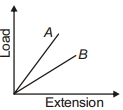
- 4In the given figure, if the dimensions of the two wires are same but materials are different, then Young's modulus is $ ........$View Solution
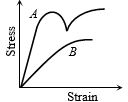
- 5The diagram shows stress v/s strain curve for the materials $A$ and $B$. From the curves we infer thatView Solution
- 6Wires $A$ and $B$ are made from the same material. $A$ has twice the diameter and three times the length of $B.$ If the elastic limits are not reached, when each is stretched by the same tension, the ratio of energy stored in $A$ to that in $B$ isView Solution
- 7View SolutionShear modulus is zero for
- 8View SolutionThe isothermal elasticity of a gas is equal to
- 9A uniform copper rod of length $50 \,cm$ and diameter $3.0 \,mm$ is kept on a frictionless horizontal surface at $20^{\circ} C$. The coefficient of linear expansion of copper is $2.0 \times 10^{-5} \,K ^{-1}$ and Young's modulus is $1.2 \times 10^{11} \,N / m ^2$. The copper rod is heated to $100^{\circ} C$, then the tension developed in the copper rod is .......... $\times 10^3 \,N$View Solution
- 10If $\rho $ is the density of the material of a wire and $\sigma $ is breaking stress, the greatest length of the wire that can hang freely without breaking isView Solution