Question
The sufrace tension and vapour pressure of water at 20°C is $7.28 \times 10^{-2}N$ $m^{-1}$ and $2.33 \times 10^3$ Pa, respectively. What is the radius of the smallest spherical water droplet which can form without evaporating at 20°C?

Answer

The drop will evaporate if the water pressure on liquid, is greater than vapour pressure above the surface of liquid. Let a water droplet of radius R be formed without evaporation then. Vapour pressure = Excess pressure in a drop$\rho=\frac{2\sigma}{\text{R}}$ (onlt one surface in drop)
$\text{R}=\frac{2\times7.28\times10^{-2}}{\text{Vapour preessure}}$
$=\frac{2\times7.28\times10^{-2}}{2.33\times10^{3}}=\frac{1456\times10}{233\times10^5}$
$\text{R}=6.25\times10^{-5}\text{m}$

Need a full question paper?

Generate a complete, print-ready paper with questions like this in minutes — across 16+ boards, with answer keys.
Start Generating Free

Similar questions

Prove that the vectors $\vec{\text{A}}=2\hat{\text{i}}-3\hat{\text{j}}+\hat{\text{k}}$ and $\vec{\text{B}}=\hat{\text{i}}+\hat{\text{j}}+\hat{\text{k}}$ are mutuallly perpendicular.
Calculate the specific heat capacity at constant volume for a gas. Given specific heat capacity at constant pressure is $6.85 \mathrm{cal} \mathrm{~mole}^{-1} \mathrm{~K}^{-2}, \mathrm{R}=8.31 \mathrm{~J} \mathrm{~mole}^{-1} \mathrm{~K}^{-1}$ and $\mathrm{J}=4.18 \mathrm{~J} \mathrm{cal}^{-1}$.
Two identical solid balls, one of ivory and the other of wet-clay, are dropped from the same height on the floor. Which one will rise to a greater height after striking the floor and why?
Should the internal energy of a system necessarily increase if heat is added to it?
The moment of inertia of a uniform rod of mass $0.50kg$ and length $1m$ is $0.10kg-m^2$ about a line perpendicular to the rod. Find the distance of this line from the middle point of the rod.
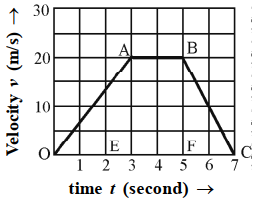
Q. 13. Draw a time graph for a vehicle from the time-velocity graph given in the attached figure.
Image
To what depth must a rubber ball be taken in deep sea so that its volume is decreased by $0.1 \%$. (The bulk modulus of rubber is $9.8 \times 10^8 \mathrm{~N} \mathrm{~m}^{-2}$, and the density of sea water is $10^3 \mathrm{~kg} \mathrm{~m}^{-3}$.)
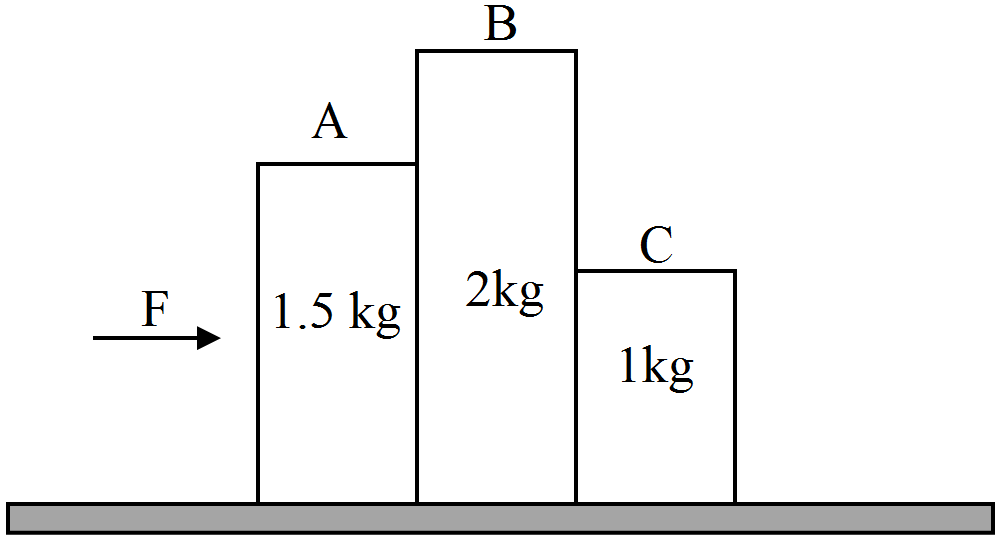
In the system of three blocks $A , B$ and C shown in figure,
(i) how large a force $F$ is needed to give the blocks an acceleration of $3 m / s ^2$, if the coefficient of friction between blocks and table is $0.27$
(ii) how large a force does the block $A$ exert on the block $B$ ?
Define kinetic energy density of a wave. Derive an expression for its maximum value. Using it, prove that the intensity of the wave is, $\text{I}=\frac{1}{2}\rho \omega^2\text{A}^2\nu.$
Ans.
The acceleration due to gravity on the moon is only one-sixth of that on earth. Suppose the average density of both are same, what would be the ratio of the radii of the moon and the earth?