MCQ
The sum of $n$ arithmetic means between $a$ and $b$, is
  • $\frac{{n(a + b)}}{2}$
  • B
    $n(a + b)$
  • C
    $\frac{{(n + 1)(a + b)}}{2}$
  • D
    $(n + 1)(a + b)$

Answer

Correct option: A.
$\frac{{n(a + b)}}{2}$
a
(a) The sum of $n$ arithmetic mean between $a$ and $b$ $ = \frac{n}{2}(a + b)$.

Aliter : As we know ${A_1} + {A_2} + ...... + {A_n} = nA$

where $A = \frac{{a + b}}{{2}}$

Need a full question paper?

Generate a complete, print-ready paper with questions like this in minutes — across 16+ boards, with answer keys.
Start Generating Free

Similar questions

If the sum of first $11$ terms of an $A.P.$, $a_{1} a_{2}, a_{3}, \ldots$is $0\left(\mathrm{a}_{1} \neq 0\right),$ then the sum of the $A.P.$, $a_{1}, a_{3}, a_{5}, \ldots, a_{23}$ is $k a_{1},$ where $k$ is equal to 
$20$ persons are invited for a party. In how many different ways can they and the host be seated at a circular table, if the two particular persons are to be seated on either side of the host
If $A = \{1, 2, 3\}$ , $B = \{1, 4, 6, 9\}$ and $R$ is a relation from $A$ to $B$ defined by ‘$x$ is greater than $y$’. The range of $R$ is
The shortest distance between the lines $\frac{x-3}{2}=\frac{y+15}{-7}=\frac{z-9}{5}$ and $\frac{x+1}{2}=\frac{y-1}{1}=\frac{z-9}{-3}$ is
If $a,\,b,\,c$ are non-coplanar vectors and $d = \lambda a + \mu \,b + \nu c,$ then $\lambda $ is equal to
The mean and variance of a random variable $X$ having a binomial distribution are $4$ and $2$ respectively, then $P(X = 1)$ is
If $A = \left[ {\begin{array}{*{20}{c}}
{ - 4}&{ - 1}\\
3&1
\end{array}} \right]$ , then the determinant of the matrix $\left( {{A^{2016}} - 2{A^{2015}} - {A^{2014}}} \right)$ is
The equation of bisectors of the angles between the lines $|x|\, = \,|y|$ are
Let,$S=\left\{\theta \in[0,2 \pi]: 8^{2 \sin ^{2} \theta}+8^{2 \cos ^{2} \theta}=16\right\}$. Then $n ( S )+\sum_{\theta \in S}\left(\sec \left(\frac{\pi}{4}+2 \theta\right) \operatorname{cosec}\left(\frac{\pi}{4}+2 \theta\right)\right)$ is equal to.
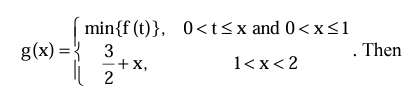
Consider the function $f:(0,2) \rightarrow R$ defined by $f(x)=\frac{x}{2}+\frac{2}{x}$ and the function $g(x)$ defined by
Image