Question
The sun emits a light with maximum wavelength $510\, mm$ while another star $X$ emits a light with maximum wavelength of $350\, nm$. What is the ratio of surface temperature of sun and the star $X$

Answer

(b)As $\lambda \propto \frac{1}{T};$ so $\frac{{{T_1}}}{{{T_2}}} = \frac{{{\lambda _2}}}{{{\lambda _1}}} = \frac{{350}}{{510}} = 0.68$

Need a full question paper?

Generate a complete, print-ready paper with questions like this in minutes — across 16+ boards, with answer keys.
Start Generating Free

Similar questions

The energy of the electromagnetic waves is of the order of 15 keV. To which part of the spectrum, does it belong?
A charge of $4.0 \mu \mathrm{C}$ is moving with a velocity of $4.0 \times 10^6 \mathrm{~ms}^{-1}$ along the positive $\mathrm{y}$-axis under a magnetic field $\vec{B}$ of strength $(2 \hat{k})\  T$. The force acting on the charge is $x \hat{i} N$. The value of $x$ is__________.
A reversible heat engine converts one-fourth of the heat input into work. When the temperature of the sink is reduced by $52\, K$, its efficiency is doubled. The temperature in Kelvin of the source will be ...... .
A ball is projected vertically down with an initial velocity from a height of $ 20 m$  onto a horizontal floor. During the impact it loses $ 50\% $ of its energy and rebounds to the same height. The initial velocity of its projection is ............ $\mathrm{m} / \mathrm{s}^{-1}$
Two identical batteries, each of $e.m.f.$ $2\, volt$ and internal resistance $1.0\, ohm$ are available to produce heat in an external resistance $R = 0.5\,ohm$ by passing a current through it. The maximum Joulean power that can be developed across $R$ using these batteries is ............. $watt$
The ends $\mathrm{Q}$ and $\mathrm{R}$ of two thin wires, $\mathrm{PQ}$ and $RS$, are soldered (joined) togetker. Initially each of the wires has a length of $1 \mathrm{~m}$ at $10^{\circ} \mathrm{C}$. Now the end $\mathrm{P}$ is maintained at $10^{\circ} \mathrm{C}$, while the end $\mathrm{S}$ is heated and maintained at $400^{\circ} \mathrm{C}$. The system is thermally insulated from its surroundings. If the thermal conductivity of wire $\mathrm{PQ}$ is twice that of the wire $RS$ and the coefficient of linear thermal expansion of $P Q$ is $1.2 \times 10^{-5} \mathrm{~K}^{-1}$, the change in length of the wire $\mathrm{PQ}$ is
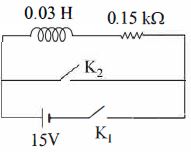
An inductor $(L = 0.03\;H)$ and a resistor $(R = 0.15 k\Omega )$ are connected in series to a battery of $15\;V$ $EMF$ in a circuit shown below. The key $K_1$ has been kept closed for a long time. Then at $t = 0$, $K_1$ is opened and key $K_2$ is closed simultaneously. At $t = 1 \;ms$, the current in the circuit will be ........... $mA$. (${e^5} \cong 150)$
A source of frequency $\nu$ gives $5$ beats/second when sounded with a source of frequency $200 \;Hz$. The second harmonic of frequency $2\nu$ of source gives $10$ beats/second when sounded with a source of frequency $420\; Hz$. The value of $v$ is .... $Hz$
A sinusoidal voltage of peak value $283\, V$ and angular frequency $320/s$ is applied to a series $LCR$ circuit. Given that $R\, = 5\,\Omega $ , $L\,= 25\, mH$ and $C\, = 1000\, \mu F$. The total impedance, and phase difference between the voltage across the source and the current will respectively be
The universal property of all substances is