Question
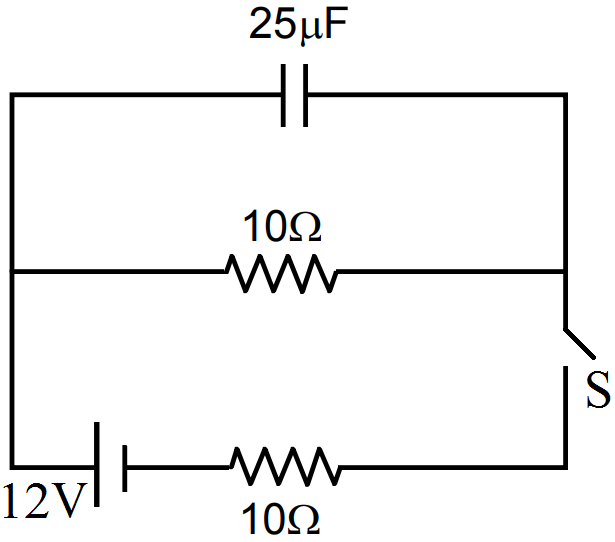
The switch S shown in figure. is kept closed for a long time and is then opened at t = 0. Find the current in the middle $1.0\Omega$ resistor at t = 1ms.
Answer

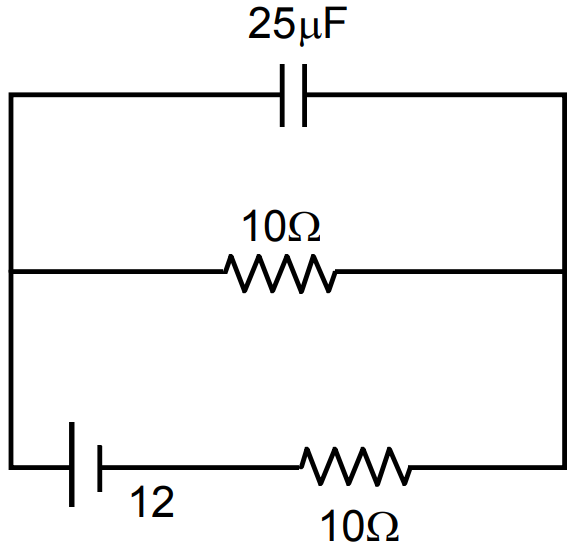
In steady state condition, no current passes through the $25\mu\text{F}$ capacitor, $\therefore$ Net resistance $=\frac{10\Omega}{2}=5\Omega$
Potential difference across the capacitor = 5 Potential difference across the $10\Omega$ resistor$=\frac{12}{5}\times10=24\text{V}$
$\text{q}=\text{Q}\Big(\text{e}^{\frac{-\text{t}}{\text{RC}}}\Big)=\text{V}\times\text{C}\Big(\text{e}^{\frac{-\text{t}}{\text{RC}}}\Big)$ $=24\times25\times10^{-6}\bigg[\text{e}^{\frac{-1\times10^{-3}}{10\times25\times10^{-4}}}\bigg]$
$=24\times25\times10^{-6}\text{e}^{-4}$
$=24\times25\times10^{-6}\times0.0183=10.9\times10^{-6}\text{C}$
Charge given by the capacitor after time t. Current in the $10\Omega$ resistor $=\frac{10.9\times10^{-6}\text{C}}{1\times10^{-3}\text{sec}}=11\text{mA}.$

Need a full question paper?

Generate a complete, print-ready paper with questions like this in minutes — across 16+ boards, with answer keys.

Start Generating Free

Similar questions

Find the components along the x, y, z axes of the angular momentum l of a particle, whose position vector is r with components x, y, z and momentum is p with components px, py and pz. Show that if the particle moves only in the x-y plane the angular momentum has only a z-component.
Two particles A and B, each carrying a charge Q, are held fixed with a separation d between them. A particle C having mass m and charge q is kept at the middle point of the line AB.
  1. If it is displaced through a distance x perpendicular to AB, what would be the electric force experienced by it.
  2. Assuming x << d, show that this force is proportional to x.
  3. Under what conditions will the particle C execute simple harmonic motion if it is released after such a small displacement?
Find the time period of the oscillations if these conditions are satisfied.
A table with smooth horizontal surface is fixed in a cabin that rotates with a uniform angular velocity $\omega$ in a circular path of radius R (In figure). A smooth groove AB of length L(<$\theta$ with the radius OA of the circle in which the cabin rotates. A small particle is kept at the point A in the groove and is released to move along AB. Find the time taken by the particle to reach the point B.
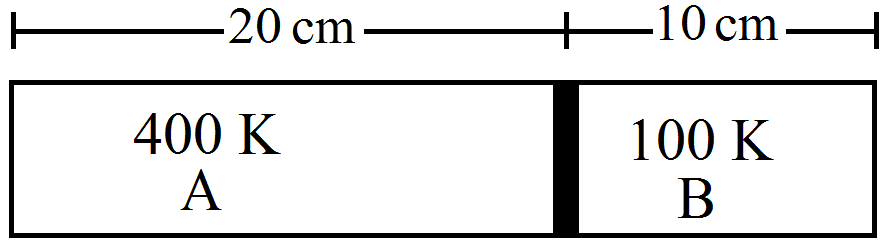
Figure. shows a cylindrical tube of length 30cm which is partitioned by a tight-fitting separator. The separator is very weakly conducting and can freely slide along the tube. Ideal gases are filled in the two parts of the vessel. In the beginning, the temperatures in the parts A and B are 400K and 100K respectively. The separator slides to a momentary equilibrium position shown in the figure. Find the final equilibrium position of the separator, reached after a long time.
The acceleration due to gravity on the surface of moon is $1.7m s^{-2}$. What is the time period of a simple pendulum on the surface of moon if its time period on the surface of earth is $3.5 s$? (g on the surface of earth is $9.8m s^{-2}$)
What do you understand by friction? Discuss about static friction, limiting friction, kinetic friction and rolling friction.
A ball of mass m, moving with a speed $2v_0$, collides inelastically $(e > 0)$ with an identical ball at rest. Show that: For a general collision, the angle between the two velocities of scattered balls is less than $90^\circ$
A person normally weighing $50kg$ stands on a massless platform which oscillates up and down harmonically at a frequency of $2.0s^{–1}$ and an amplitude $5.0cm$. A weighing machine on the platform gives the persons weight against time.
  1. Will there be any change in weight of the body, during the oscillation?
  2. If answer to part (a) is yes, what will be the maximum and minimum reading in the machine and at which position?
A $20\mu\text{F}$ capacitor is joined to a battery of emf 6.0V through a resistance of $100\Omega.$ Find the charge on the capacitor 2.0ms after the connections are made.
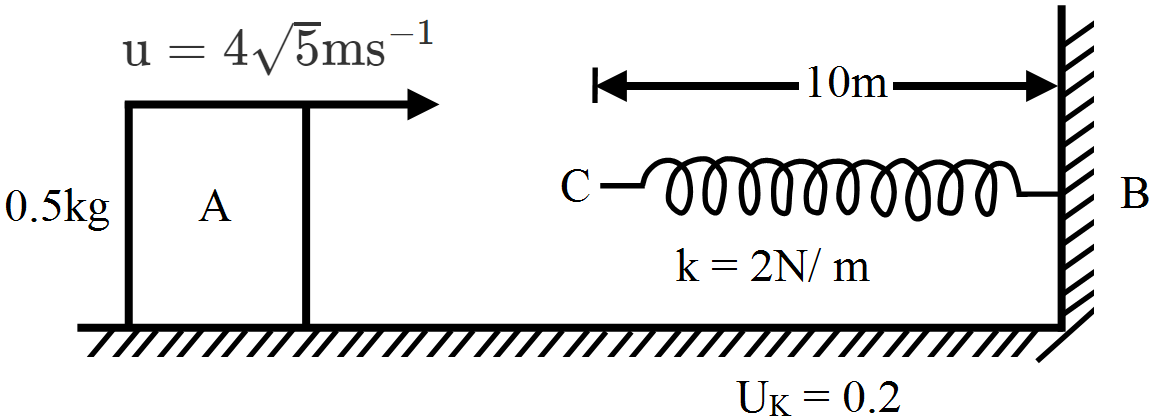
A $0.5kg$ block slides from the point A on a horizontal track with an initial speed $4\sqrt{5}\text{ms}^{-1}$ towards a weightless horizontal spring of length $10m$ and spring constant 2 N/ m.
The initial track is frictionless and part BC under the unstretched length of spring has coefficient of kinetic friction $\mu_\text{k}=0.2$ Calculate total distance by which the block move before coming finally to rest. $(g = 10ms^{-1})$.