MCQ
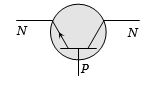
The symbol given in figure represents
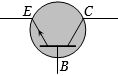
  • $NPN$ transistor
  • B
    $PNP$ transistor
  • C
    Forward biased $PN $ junction diode
  • D
    Reverse biased $NP$ junction diode

Answer

Correct option: A.
$NPN$ transistor
a
(a)The arrow head in the transistor symbol always shows the direction of hole flow in the emitter region.

Need a full question paper?

Generate a complete, print-ready paper with questions like this in minutes — across 16+ boards, with answer keys.
Start Generating Free

Similar questions

A person suffering from myopia cannot see clearly :
The ionisation potential of hydrogen atom is $13.6$ volt. The energy required to remove an electron from the second orbit of hydrogen is......$eV$
The electrons are emitted in the photoelectric effect from a metal surface
In which type of molecule positive and negative charges does not coincide with each other?
Two identical short bar magnets, each having magnetic moment $M$ are placed a distance of $2d$ apart with axes perpendicular to each other in a horizontal plane. The magnetic induction at a point midway between them is 
A bi convex lens of focal length $10\,cm$ is cut in two identical parts along a plane perpendicular to the principal axis. The power of each lens after cut is $...........\,D$.
$n$ identical cells each of $e.m.f.$ $E$ and internal resistance $r$ are connected in series. An external resistance $R$ is connected in series to this combination. The current through $R$ is
Which of the following law is used in the Millikan's method for the determination of charge
Dipole having dipole moment $4\,C-m$ is placed on origin along $x-$ axis. Point charge of $8\,\mu C$ is fixed at $(4, 0, 0)$ . Now dipole is rotated by an angle of $\frac{\pi }{2}$ . Find the work done (in $mJ$ ) in rotating the dipole.......$mJ$
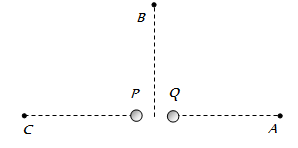
Figure here shows P and Q as two equally intense coherent sources emitting radiations of wavelength 20 m. The separation PQ is 5.0 m and phase of P is ahead of the phase of Q by $90^{\circ}$. A, B and C are three distant points of observation equidistant from the mid-point of PQ. The intensity of radiations at A, B, C will bear the ratio