Question
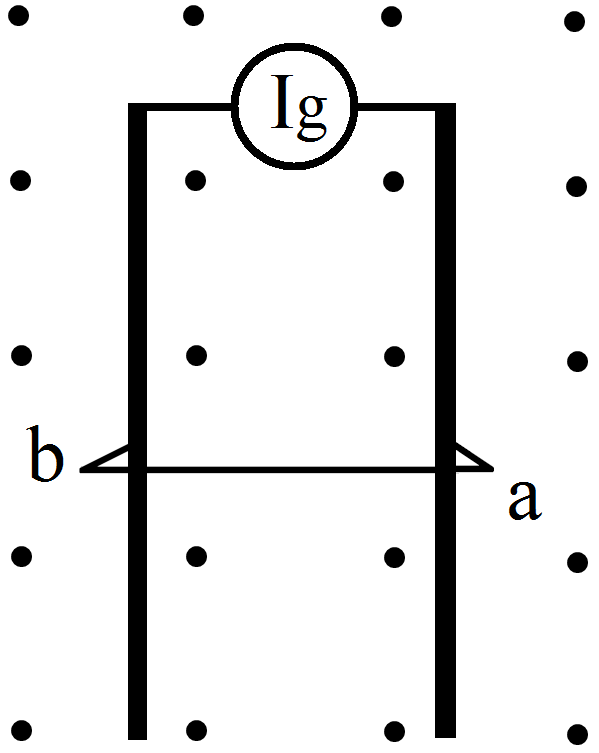
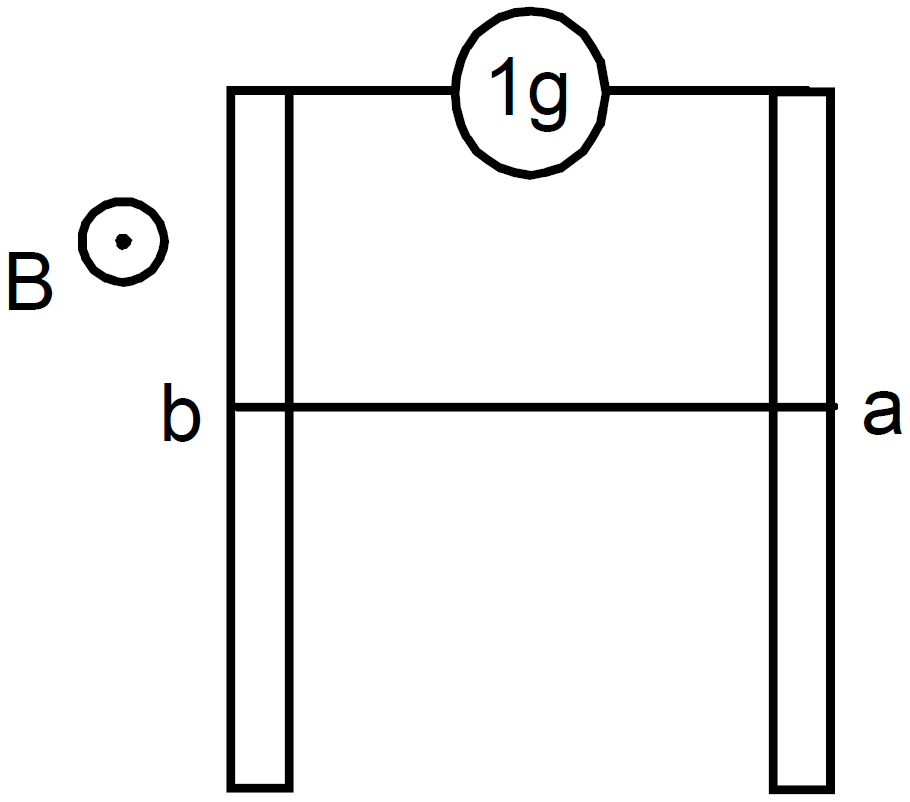
The system containing the rails and the wire of the previous problem is kept vertically in a uniform horizontal magnetic field B that is perpendicular to the plane of the rails (figure). It is found that the wire stays in equilibrium. If the wire ab is replaced by another wire of double its mass, how long will it take in falling through a distance equal to its length?
Answer


Given Blv = mg …(1)
When wire is replaced we have
2mg - Blv = 2ma [where a → acceleration]
$\Rightarrow\text{a}=\frac{2\text{mg}-\text{Blv}}{2\text{m}}$
Now, $\text{s}=\text{ut}+\frac{1}{2}\text{at}^2$
$\Rightarrow\text{l}=\frac{1}{2}\times\frac{2\text{mg}-\text{Blv}}{2\text{m}}\times\text{t}^2 \ \big[\therefore \ \text{s}=\text{l}\big]$
$\Rightarrow\text{t}=\sqrt{\frac{4\text{ml}}{2\text{mg}-\text{Blv}}}=\sqrt{\frac{4\text{ml}}{2\text{mg}-\text{mg}}}=\sqrt{\frac{2\text{l}}{\text{g}}}$ [from (1)]

Need a full question paper?

Generate a complete, print-ready paper with questions like this in minutes — across 16+ boards, with answer keys.

Start Generating Free

Similar questions

An object is placed at a distance of 30cm from a converging lens of focal length 15cm. A normal eye (near point 25cm, far point infinity) is placed close to the lens on the other side.
  1. Can the eye see the object clearly?
  2. What should be the minimum separation between the lens and the eye so that the eye can clearly see the object?
  3. Can a diverging lens, placed in contact with the converging lens, help in seeing the object clearly when the eye is close to the lens?
A circular disc made of iron is rotated about its axis at a constant velocity to $\omega$. Calculate the percentage change in the linear speed of a particle of the rim as the disc is slowly heated from $20^{\circ} \mathrm{C}$ to $50^{\circ} \mathrm{C}$ keeping the angular velocity constant. Coefficient of linear expansion of iron $=1.2 \times 10^{-5}{ }^{\circ} \mathrm{C}^{-1}$.
Establish expressions for the force and torque on an electric dipole located in a uniform electric field. Find the value of torque for each case.
In an agricultural experiment, a solution containing 1 mole of a radioactive material $\Big(\text{t}_{\frac{1}{2}}=14.3\text{ days}\Big)$ was injected into the roots of a plant. The plant was allowed 70 hours to settle down and then activity was measured in its fruit. If the activity measured was $1\mu\text{Ci},$ what per cent of activity is transmitted from the root to the fruit in steady state?
A gas is enclosed in a cylindrical can fitted with a piston. The walls of the can and the piston are adiabatic. The initial pressure, volume and temperature of the gas are 100kPa, $400cm^3$ and 300K, respectively. The ratio of the specific heat capacities of the gas is $\frac{\text{C}_\text{P}}{\text{C}_\text{V}}=1.5.$ Find the pressure and the temperature of the gas if it is,
  1. Suddenly compressed.
  2. Slowly compressed to $100cm^3.$
  1. An object is placed in front of a concave mirror. It is observed that a virtual image is formed. Draw the ray diagram to show the image formation and hence derive the mirror equation $\frac{1}{\text{f}}=\frac{1}{\text{u}}+\frac{1}{\text{v}}.$
  2. An object is placed 30cm in front of a plano-convex lens with its spherical surface of radius of curvature 20cm. If the refractive index of the material of the lens is 1.5, find the position and nature of the image formed.
A particle of charge $2.0 \times 10^{-8}C$ and mass $2.0 \times 10^{-10}g$ is projected with a speed of $2.0 \times 10^3m/s^{-1}$ in a region with a uniform magnetic field of 0.10T. The velocity is perpendicular to the field. Find the radius of the circle formed by the particle and also the time period.
The terminology of different parts of the electromagnetic spectrum is given in the text. Use the formula E = hν (for energy of a quantum of radiation: photon) and obtain the photon energy in units of eV for different parts of the electromagnetic spectrum. In what way are the different scales of photon energies that you obtain related to the sources of electromagnetic radiation?
The wavelengths of $\text{K}_\alpha$ and $\text{L}_\alpha$ X-rays of a material are 21.3pm and 141pm respectively. Find the wavelength of $\text{K}_\beta$ X-ray of the material.
Consider a thin target $(10^{-2}m$ square, $10^{-3}m$ thickness$)$ of sodium, which produces a photocurrent of 100μA when a light of intensity $100W/m^2 (\lambda = 660nm)$ falls on it. Find the probability that a photoelectron is produced when a photons strikes a sodium atom. $[$Take density of $Na = 0.97 kg/m^3].$