- An object is placed in front of a concave mirror. It is observed that a virtual image is formed. Draw the ray diagram to show the image formation and hence derive the mirror equation $\frac{1}{\text{f}}=\frac{1}{\text{u}}+\frac{1}{\text{v}}.$
- An object is placed 30cm in front of a plano-convex lens with its spherical surface of radius of curvature 20cm. If the refractive index of the material of the lens is 1.5, find the position and nature of the image formed.
CBSE 55-1-3 PAPER SET 2020
Download our app for free and get started
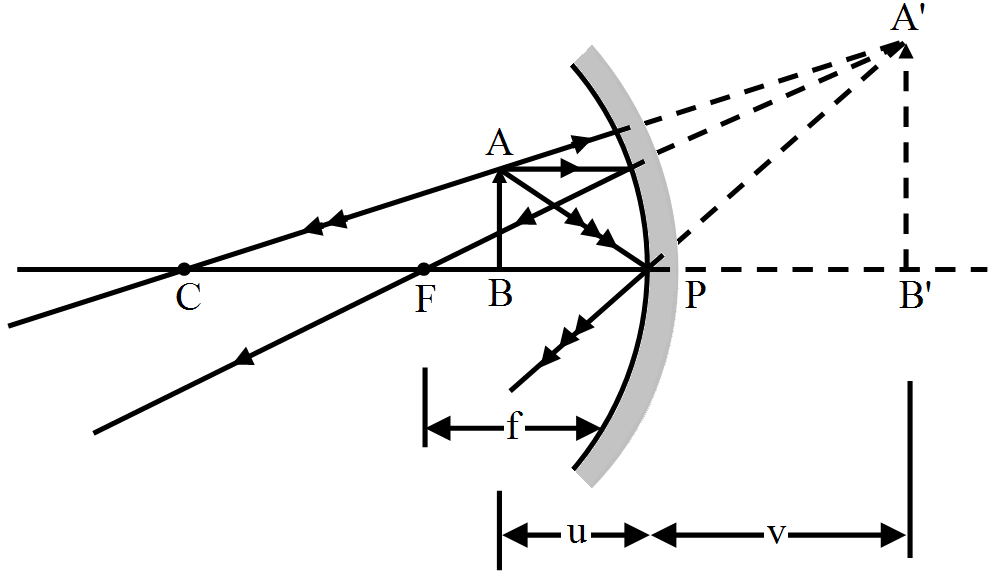
$\triangle\text{ABC}\sim\triangle\text{A}_1\text{B}_1\text{C}$
$\Rightarrow\frac{\text{A}_1\text{B}_1}{\text{AB}}=\frac{\text{A}_1\text{C}}{\text{AC}}=\frac{(+\text{v})+(-\text{R)}}{(-\text{R})-(-\text{u)}}\ ...(1)$
$\triangle\text{ABP}\sim\triangle\text{A}_1\text{B}_1\text{P}$
$\Rightarrow\frac{\text{A}_1\text{B}_1}{\text{AB}}=\frac{\text{A}_1\text{P}}{\text{AP}}=\frac{+\text{v}}{-\text{u}}\ ...(2)$
$(1)=(2)$
$\Rightarrow\frac{\text{v}-\text{R}}{-\text{R}+\text{u}}=\frac{\text{v}}{-\text{u}}$
$\Rightarrow-\text{uv}+\text{uR}=-\text{vR}+\text{uv}$
$\Rightarrow\text{uR}+\text{vR}=2\text{uv}$
$\div\text{ by }\text{uvR}$
$\Rightarrow\frac{1}{\text{v}}+\frac{1}{\text{u}}=\frac{2}{\text{R}}$
$\because\text{R}=2\text{F}$
$\therefore\frac{1}{\text{v}}+\frac{1}{\text{u}}=\frac{1}{\text{f}}$
- $\frac{1}{\text{f}}=(1.5-1)\Big(\frac{1}{20}-\frac{1}{\infty}\Big)$
$\therefore\text{f}=40\text{cm}$
Now, $\frac{1}{\text{f}}=\frac{1}{\text{v}}-\frac{1}{\text{v}}$
$\Rightarrow\text{v}=\frac{\text{fu}}{\text{f}+\text{u}}=\frac{40\times-30}{40-30}$
$\Rightarrow\text{v}=\frac{-40\times30}{10}=-120\text{cm}$
Image is virtual, erect and enlarged in front of lens 120cm away.

Download our appand get started for free
Experience the future of education. Simply download our apps or reach out to us for more information. Let's shape the future of learning together!No signup needed.*
Similar Questions
- 1View Solution
- Draw a ray diagram showing the image formation by a compound microscope. Hence obtain expression for total magnification when the image is formed at infinity.
- Distinguish between myopia and hypermetropia. Show diagrammatically how these defects can be corrected.
- 2View SolutionA pin of length 2.0cm lies along the principal axis of a converging lens, the centre being at a distance of 11cm from the lens. The focal length of the lens is 6cm. Find the size of the image.
- 3Three thin prisms are combined as shown in figure. The refractive indices of the crown glass for red, yellow and violet rays are $\mu_\text{r},\mu_\text{y}$ and $\mu_\text{v}$ respectively and those for the flint glass are $\mu'_\text{r},\mu'_\text{y}$ and $\mu'_\text{v}$ respectively. Find the ratio $\frac{\text{A}'}{\text{A}}$ for which.View Solution
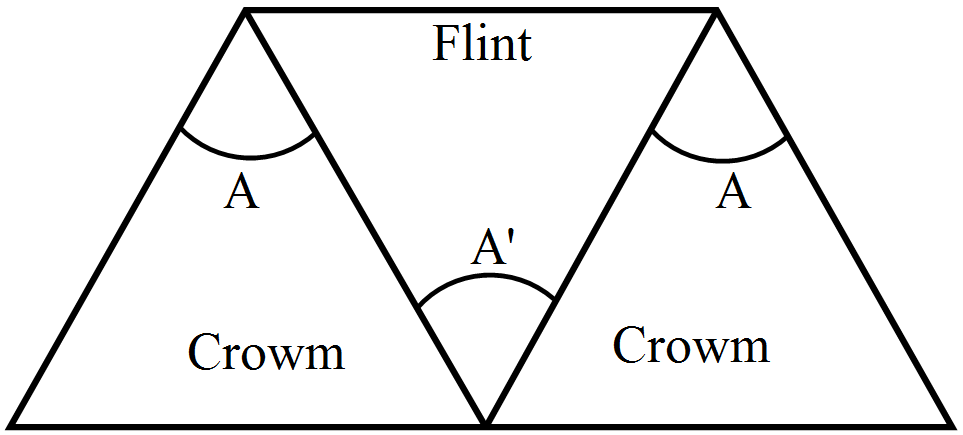
- There is no net angular dispersion.
- There is no net deviation in the yellow ray.
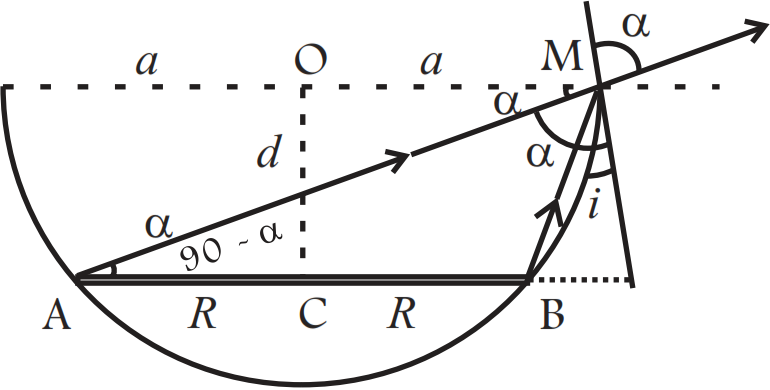
- 4View SolutionA circular disc of radius 'R' is placed co-axially and horizontally inside an opaque hemispherical bowl of radius 'a' (Fig). The far edge of the disc is just visible when viewed from the edge of the bowl. The bowl is filled with transparent liquid of refractive index μ and the near edge of the disc becomes just visible. How far below the top of the bowl is the disc placed?
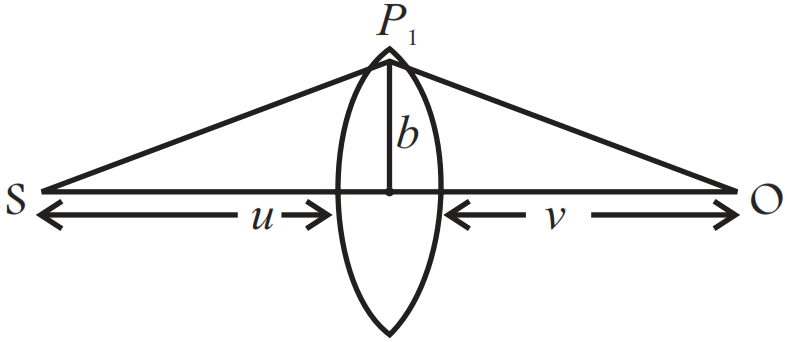
- 5Consider a thin lens placed between a source (S) and an observer (O) (Fig). Let the thickness of the lens vary as $\text{w}\text{(b)}=\text{w}_0-\frac{\text{b}^2}{\alpha}$, where b is the verticle distance from the pole. $w_0$ is a constant. Using Fermat’s principle i.e. the time of transit for a ray between the source and observer is an extremum, find the condition that all paraxial rays starting from the source will converge at a point O on the axis. Find the focal length.View Solution
- 6View SolutionAt what angle should a ray of light be incident on the face of a prism of refracting angle 60° so that it just suffers total internal reflection at the other face? The refractive index of the material of the prism is 1.524.
- 7View SolutionTwo convex lenses, each of focal length 10cm, are placed at a separation of 15cm with their principal axes coinciding,
- Show that a light beam coming parallel to the principal axis diverges as it comes out of the lens system.
- Find the location of the virtual image formed by the lens system of an object placed far away.
- Find the focal length of the equivalent lens.
- 8View SolutionA pin of length 2.00cm is placed perpendicular to the principal axis of a converging lens. An inverted image of size 1.00cm is formed at a distance of 40.0cm from the pin. Find the focal length of the lens and its distance from the pin.
- 9Show that for a material with refractive index $\mu\geq\sqrt{2}$, light incident at any angle shall be guided along a length perpendicular to the incident face.View Solution
- 10View SolutionA gun of mass M fires a bullet of mass m with a horizontal speed V. The gun is fitted with a concave mirror of focal length f facing tpwards the receding bullet. Find the speed of separation of the bullet and the image just after the gun was fired.