MCQ
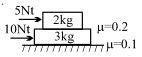
The system shown in figure is released then $a_1$ and $a_2$ is
  • A
    $a_1 = 0.35 m/s^2 ; a_2 = 4.5 m/s^2$
  • B
    $a_1 = 3 m/s^2 ; a_2 = 0.5 m/s^2$
  • $a_1 = 2 m/s^2 ; a_2 = 2 m/s^2$
  • D
    $a_1 = 0.5 m/s^2 ; a_2 = 3 m/s^2$

Answer

Correct option: C.
$a_1 = 2 m/s^2 ; a_2 = 2 m/s^2$
c

Need a full question paper?

Generate a complete, print-ready paper with questions like this in minutes — across 16+ boards, with answer keys.
Start Generating Free

Similar questions

A $20$ $cm$ long capillary tube is dipped in water. The water rises up to $8$ $cm$. If entire arrangement is put in a freely falling elevater the length of water coloumn in the capillary will be ....... $cm$
A man weighing $80\, kg$ is standing in a trolley weighing $320 \,kg$. The trolley is resting on frictionless horizontal rails. If the man starts walking on the trolley with a speed of $1 \,m / s$, then after $4\, sec$ his displacement relative to the ground will be ........ $m$
$N$ molecules each of mass $m$ of gas $A$ and $2N$ molecules each of mass $2m$ of gas $B$ are contained in the same vessel at temperature $T.$ The mean square of the velocity of molecules of gas $B$ is ${v^2}$ and the mean square of $x$ component of the velocity of molecules of gas $A$ is ${w^2}$. The ratio $\frac{{{w^2}}}{{{v^2}}}$ is
When a body moves with a constant speed along a circle
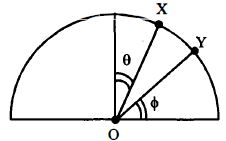
A particle is released on a vertical smooth semicircular track from point $X$ so that $OX$ makes angle $\theta $ from the vertical ( see figure). The normal reaction of the track on the particle vanishes at point $Y$ where $OY$ makes angle $\phi $ with the horizontal. Then
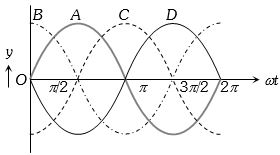
The figure shows four progressive waves $A, B, C$ and $D $ with their phases expressed with respect to the wave $A$. It can be concluded from the figure that
A body is moving unidirectionally under the influence of a source of constant power supplying energy. Which of the diagrams shown in correctly shows the displacement-time curve for its motion?

Two waves having equations

${x_1} = a\sin (\omega \,t + {\phi _1})$, ${x_2} = a\sin \,(\omega \,t + {\phi _2})$

If in the resultant wave the frequency and amplitude remain equal to those of superimposing waves. Then phase difference between them is

A particle starts from rest and performing circular motion of constant radius with speed given by $v = \alpha \sqrt x$ where $\alpha$ is a constant and $x$ is the distance covered. The correct graph of magnitude of its tangential acceleration $(a_t)$ and centripetal acceleration $(a_c)$ versus $t$ will be:
The speed of sound in a gas, in which two waves of wavelength $1.0\,\, m$ and $1.02\,\, m$ produce $6$ beats per second, is approximately .... $m/s$