MCQ
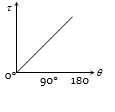
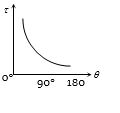
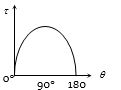
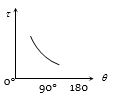
The ($\tau -\theta$) graph for a coil is

  • B

  • C

  • D

Answer

Correct option: A.

a
(a) $\tau = NBiA\sin \theta $ so the graph between $\tau $ and $\theta $ is a sinusoidal graph.

Need a full question paper?

Generate a complete, print-ready paper with questions like this in minutes — across 16+ boards, with answer keys.
Start Generating Free

Similar questions

The net applied force on a body in uniform circular motion should always be
A wheel is rotating about an axis through its centre at $720\, rpm$. It is acted on by a constant torque opposing its motion for $8\, seconds$ to bring it to rest finally. The value of torque (in $N-m$) is  (Given $I = \frac{{24}}{\pi }kg - {m^2}$ )
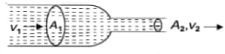
A liquid flows in the tube from left to right as shown in figure. $A_1$ and $A_2$ are the cross-sections of the portions of the tube as shown. The ratio of speed $\frac{v_1}{v_2}$ will be .......... 
A lift is moving downwards with an acceleration equal to acceleration due to gravity. $A$ body of mass $M$ kept on the floor of the lift is pulled horizontally. If the coefficient of friction is $\mu $, then the frictional resistance offered by the body is
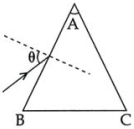
Monochromatic light is incident on a glass prism of angle $A$. If the refractive index of the material of the prism is $μ$, a ray, incident at an angle $\theta$, on the face $AB$ would get transmitted through the face $AC$ of the prism provided
A ball of mass $0.1$ kg is suspended by a string. It is displaced through an angle of ${60^o}$ and left. When the ball passes through the mean position, the tension in the string is ........ $N$
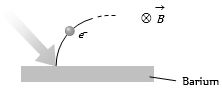
Light of wavelength $2475\, Å$ is incident on barium. Photoelectrons emitted describe a circle of radius $100\, cm$ by a magnetic field of flux density $\frac{1}{{\sqrt {17} }} \times {10^{ - 5}}$ $Tesla$. Work function of the barium is .............. $eV$ (Given $\frac{e}{m} = 1.7 \times {10^{11}})$
Which of the following is the unit of specific heat
A car is moving at a speed of $40\,m/s$ on a circular track of radius $400\,m.$ This speed is increasing at the rate of $3\,m/s^2.$ The acceleration of car is  ........ $m/s^2$
If the axis of rotation of the earth were extended into space, then it would pass close to