MCQ
The temperature at which all three states of matter are in equilibrium is called:
  • A
    Critical point
  • Triple point
  • C
    Inversion point
  • D
    Boyle point

Answer

Correct option: B.
Triple point
B

Need a full question paper?

Generate a complete, print-ready paper with questions like this in minutes — across 16+ boards, with answer keys.
Start Generating Free

Similar questions

A travelling wave represented by $y = A \sin (\omega t - kx )$ is susperimposed on another wave represented by $y = A$ $\sin (\omega t + kx )$. The resultant is
A block of mass $m$ rests on a platform. The platform is given up and down $SHM$ with an amplitude $d$ . What can be the maximum frequency so that the block never leaves the platform
A spherical body of mass $2\,kg$ starting from rest acquires a kinetic energy of $10000\,J$ at the end of $5^{\text {th }}$ second. The force acted on the body is $.....N$
A physical quantity $'x'$ is calculated from the relation $x = \frac{{{a^2}{b^3}}}{{c\sqrt d }}$ in $a$,$b$,$c$ and $d$ are $2\%$, $1 \%$, $3\%$ and $4\%$ respectively, what is the percentage error in $x$.
At the top of the trajectory of a projectile, the directions of its velocity and acceleration are
Two identical  $5\,\,kg$ . blocks are moving with same speed of  $2\,\,m/s$  towards each other along a frictionless horizontal surface. The two blocks collide, stick together and come to rest. Consider to two blocks as a system, the work done on the system by the external forces will be ............. $\mathrm{Joule}$
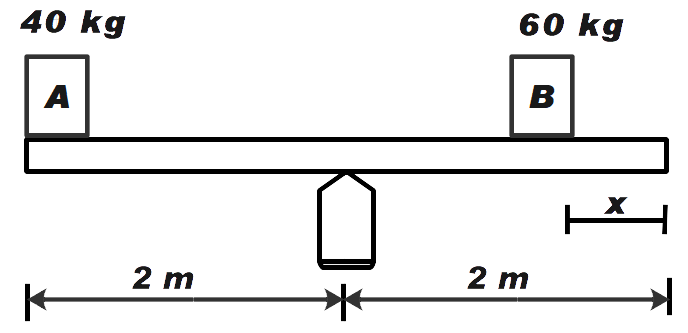
In the game of see$-$saw, what should be the displacement of boy $B$ from right edge to keep the see$-$saw in equilibrium? $(M = 40\ kg, M_2 = 60\ kg.)$
Image
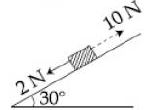
A block kept on a rough inclined plane, as shown in the figure, remains at rest upto a maximum force $2\,N$ down the inclined plane. The maximum external force up the inclined plane that does not move the block is $10\,N.$ The coefficient of static friction between the block and the plane is : [Take $g = 10\,m/s^2$ ]
A body is thrown at angle $30^{\circ}$ to the horizontal with the velocity of $30\; m / s$. After $1\;sec$, its velocity will be (in $m/s$) $\left(g=10\; m / s ^{2}\right)$
If the atmospheric pressure is $P_a$, then the pressure $P$ at depth $h$ below the surface of liquid of density $\rho $ open to the atmosphere is