MCQ
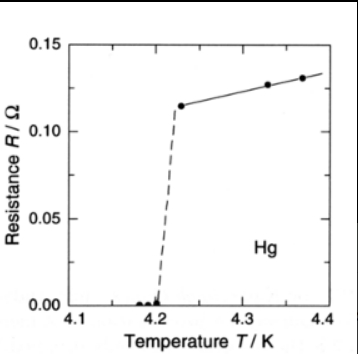
The temperature bellow which a material becomes a superconductor is called:
- ✓Critical temperature.
- BAbsolute temperature.
- CTripple point.
- DNone of the above.
Critical temperature is the temperature below which metals when taken exhibit zero resistivity and turns into a superconductor. The critical temperature varies with the individual material. Because these materials have no electrical resistance, meaning electrons can travel freely through them, they can carry large amounts of electrical current for long periods of time without losing energy as heat. The transition is so sudden and complete that it appears to be a transition to a different phase of matter; known as the superconducting phase.
Generate a complete, print-ready paper with questions like this in minutes — across 16+ boards, with answer keys.
Planck's constant $h=6.63 \times 10^{-34}\, J . s$
Speed of ligh $c =3 \times 10^{8}\, m / s$
Assertion $A$: The potential ( $V$ ) at any axial point, at $2 \mathrm{~m}$ distance ( $r$ ) from the centre of the dipole of dipole moment vector $\vec{P}$ of magnitude, $4 \times 10^{-6} \mathrm{C} \mathrm{m}$, is $\pm 9 \times 10^3 \mathrm{~V}$.
(Take $\frac{1}{4 \pi \in_0}=9 \times 10^9 \mathrm{Sl}$ units)
Reason $R$: $V= \pm \frac{2 P}{4 \pi \in_0 r^2}$, where $r$ is the distance of any axial point, situated at $2 \mathrm{~m}$ from the centre of the dipole.
In the light of the above statements, choose the correct answer from the options given below: