The temperature coefficient of resistance for a wire is $0.00125\,^oC$. At $300\,K$ its resistance is $1\, ohm$. The temperature at which the resistance becomes $2\, ohm$ is .......... $K$
IIT 1980, Medium


Download our appand get started for free
Experience the future of education. Simply download our apps or reach out to us for more information. Let's shape the future of learning together!No signup needed.*
Similar Questions
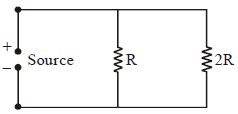
- 1The charge supplied by source varies with time $'t'$ as $Q = at -bt^2$. The total heat produced in the resistor $2R$ before current reduces to zeroView Solution
- 2In a potentiometer experiment, it is found that no current passes through the galvanometer when the terminals of the cell are connected across $52\ cm$ of the potentiometer wire. If the cell is shunted by a resistance of $ 5\,\Omega$, a balance is found when the cell is connected across $40\ cm$ of the wire. Find the internal resistance of the cell ........... $\Omega$View Solution
- 3A wire of resistance $R$ is divided in $10$ equal parts. These parts are connected in parallel, the equivalent resistance of such connection will beView Solution
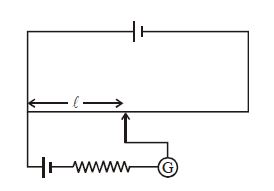
- 4In a potentiometer (see figure) a balance is obtained at a length of $400\ mm$ when using a known battery of emf $1.6\ V$. After removing this battery, another battery of unknown emf is used and balance is obtained at a length of $650\ mm.$ The emf of unknown battery is ............. $volt$View Solution
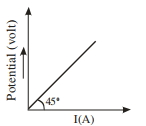
- 5The variation of applied potential and current flowing through a given wire is shown in figure. The length of wire is $31.4 \,cm$. The diameter of wire is measured as $2.4 \,cm$. The resistivity of the given wire is measured as $x \times 10^{-3} \,\Omega cm$. The value of $x$ is_______ [Take $\pi=3.14]$View Solution
- 6For a cell of $e.m.f.$ $2\,V$, a balance is obtained for $50\, cm$ of the potentiometer wire. If the cell is shunted by a $2\,\Omega $ resistor and the balance is obtained across $40\, cm$ of the wire, then the internal resistance of the cell is ............. $\Omega $View Solution
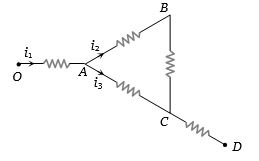
- 7The current in the arm $CD$ of the circuit will beView Solution
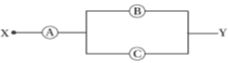
- 8$A, \,B$ and $C$ are voltmeters of resistance $R, \,1 .5R$ and $3R$ respectively as shown in the figure. When some potential difference is applied between $X$ and $Y,$ the voltmeter readings are $V_A, \,V_B$ and $V_C$ respectively. ThenView Solution
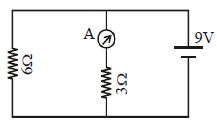
- 9In the figure shown, if the internal resistance of the battery is $1\, ohm$ , the reading of the ammeter will be ................. $\mathrm{A}$View Solution
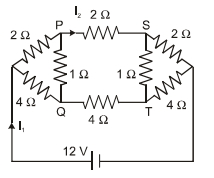
- 10For the resistance network shown in the figure, choose the correct option$(s)$. $Image$View Solution
$(A)$ The current through $P Q$ is zero.
$(B)$ $I_1=3 A$.
$(C)$ The potential at $S$ is less than that at $Q$.
$(D)$ $I _2=2 A$.