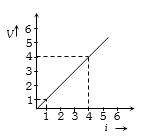
Variation of current and voltage in a conductor has been shown in the diagram below. The resistance of the conductor is. ........... $ohm$
Easy


Download our appand get started for free
Experience the future of education. Simply download our apps or reach out to us for more information. Let's shape the future of learning together!No signup needed.*
Similar Questions
- 1A steady current $I$ flows through a wire of radius $r$, length $L$ and resistivity $\rho$. The current produces heat in the wire. The rate of heat loss in a wire is proportional to its surface area. The steady temperature of the wire is independent ofView Solution
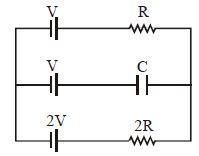
- 2View SolutionIn the given circuit, with steady current, the potential drop across the capacitor must be
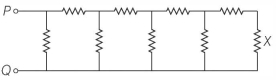
- 3Consider the circuit shown below where all resistors are $1 \,k \Omega$. If a current of magnitude $1 \,mA$ flows through the resistor marked $X$, the potential difference measured between points $P$ and $Q$ are ..............$V$View Solution
- 4The charge flowing through a resistor $R$ varies with time $t$ as $Q = 3t -6t^2.$ The heat produced in $R$ till the current in it becomes zero isView Solution
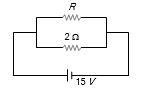
- 5If in the circuit, power dissipation is $150\, W$, then $R$ is ............... $\Omega$View Solution
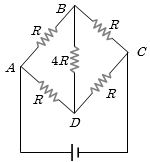
- 6Five resistors of given values are connected together as shown in the figure. The current in the arm $BD$ will beView Solution
- 7An electric fan and a heater are marked as $100\, watt$, $220\, volt$ and $1000\, watt$, $220\, volt$ respectively. The resistance of the heater isView Solution
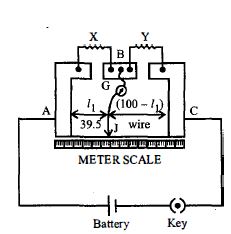
- 8In a meter bridge, as shown in the figure, it is given that resistance $Y=12.5\, \Omega $ and that the balance is obtained at a distance $39.5\, cm$ from end $A$ (by jockey $J$) . After interchanging the resistances $X$ and $Y$, a new balance point is found at a distance $l_2$ from end $A$. What are the values of $X$and $l_2$ ?View Solution
- 9A flow of $10^{7}$ electrons per second in a conducting wire constitutes a current ofView Solution
- 10An ideal battery of $4\, V$ and resistance $R$ are connected in series in the primary circuit of a potentiometer of length $1\, m$ and resistance $5\,\Omega $ . The value of $R$, to give a difference of $5\, mV$ across $10\, cm$ of potentiometer wire, is: ................ $\Omega$View Solution