Question
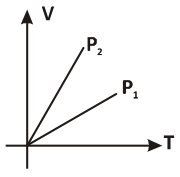
The temperature of a hypothetical gas increases to $\sqrt 2 $ times when compressed adiabatically to half the volume. Its equation can be written as
$P{V^{3/2}}$= constant
Generate a complete, print-ready paper with questions like this in minutes — across 16+ boards, with answer keys.
Reason $(R)$: In elastic collision, the linear momentum of the system is conserved.
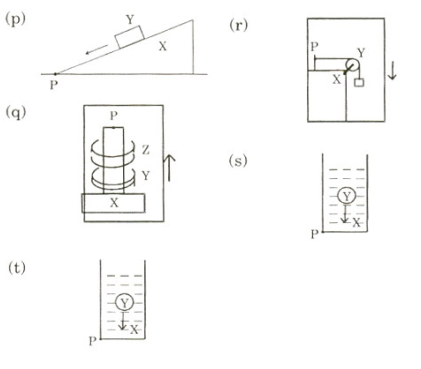
| Column $I$ | Column $II$ |
| $(A)$ The force exerted by $\mathrm{X}$ on $\mathrm{Y}$ has a magnitude $\mathrm{Mg}$. | $Image$ Block $Y$ of mass $M$ left on a fixed inclined plane $\mathrm{X}$, slides on it with a constant velocity. |
| $(B)$ The gravitational potential energy of $\mathrm{X}$ is continuously increasing. | $Image$ Two ring magnets $\mathrm{Y}$ and $\mathrm{Z}$, each of mass $M$, are kept in frictionless vertical plastic stand so that they repel each other. $Y$ rests on the base $X$ and $\mathrm{Z}$ hangs in air in equilibrium. $\mathrm{P}$ is the topmost point of the stand on the common axis of the two rings. The whole system is in a lift that is going up with a constant velocity. |
| $(C)$ Mechanical energy of the system $\mathrm{X}+\mathrm{Y}$ is continuously decreasing. | $Image$ A pulley $Y$ of mass $m_0$ is fixed to a table through a clamp $X$. A block of mass $M$ hangs from a string that goes over the pulley and is fixed at point $\mathrm{P}$ of the table. The whole system is kept in a lift that is going down with a constant velocity. |
| $(D)$ The torque of the weight of $\mathrm{Y}$ about point $\mathrm{P}$ is zero. | $Image$ A sphere $\mathrm{Y}$ of mass $M$ is put in a nonviscous liquid $\mathrm{X}$ kept in a container at rest. The sphere is released and it moves down in the liquid. |
| $Image$ A sphere $\mathrm{Y}$ of mass $M$ is falling with its terminal velocity in a viscous liquid $\mathrm{X}$ kept in a container. |
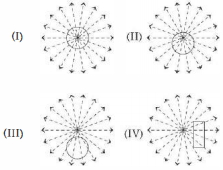
$(a)$ the gravitational field is zero
$(b)$ the gravitational potential is zero
$(c)$ the gravitational field is same everywhere
$(d)$ the gravitation potential is same everywhere
$(e)$ all of the above
Choose the most appropriate answer from the options given below