MCQ
The temperature of a hypothetical gas increases to $\sqrt 2 $ times when compressed adiabatically to half the volume. Its equation can be written as
  • $P{V^{3/2}}$= constant
  • B
    $P{V^{5/2}}$= constant
  • C
    $P{V^{7/3}}$= constant
  • D
    $P{V^{4/3}}$= constant

Answer

Correct option: A.
$P{V^{3/2}}$= constant
a
(a) $T{V^{\gamma - 1}}$= constant
$\therefore  \frac{{{T_1}}}{{{T_2}}} = {\left( {\frac{{{V_2}}}{{{V_1}}}} \right)^{\gamma - 1}}$or ${\left( {\frac{1}{2}} \right)^{\gamma - 1}} = \sqrt {\frac{1}{2}} $
 $\therefore \gamma - 1 = \frac{1}{2}$or $\gamma = \frac{3}{2}$

$P{V^{3/2}}$= constant

Need a full question paper?

Generate a complete, print-ready paper with questions like this in minutes — across 16+ boards, with answer keys.

Start Generating Free

Similar questions

Three liquids of densities $d,\,2d$ and $3d$ are mixed in equal volumes. Then the density of the mixture is
At what point of a projectile motion acceleration and velocity are perpendicular to each other
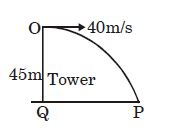
In the figure shown, velocity of the particle at $P \,(g = 10\,m/s^2)$
A body is at rest under the action of three forces, two of which are ${\vec F_1} = 4\hat i,\,{\vec F_2} = 6\hat j,$ the third force is
Column $I$ describe some situations in which a small object moves. Column $II$ describes some characteristics of these motions. Match the situation in Column $I$ with the characteristics in Column $II$ and indicate your answer by darkening appropriate bubbles in the $4 \times 4$ matrix given in the $ORS$.
Column $I$ Column $II$
$(A)$ The object moves on the $\mathrm{x}$-axis under a conservative force in such a way that its "speed" and "position" satisfy $v=c_1 \sqrt{c_2-x^2}$, where $\mathrm{c}_1$ and $\mathrm{c}_2$ are positive constants. $(p)$ The object executes a simple harmonic motion.
$(B)$ The object moves on the $\mathrm{x}$-axis in such a way that its velocity and its displacement from the origin satisfy $\mathrm{v}=-\mathrm{kx}$, where $\mathrm{k}$ is a positive constant. $(q)$ The object does not change its direction.
$(C)$ The object is attached to one end of a massless spring of a given spring constant. The other end of the spring is attached to the ceiling of an elevator. Initially everything is at rest. The elevator starts going upwards with a constant acceleration a. The motion of the object is observed from the elevator during the period it maintains this acceleration. $(r)$ The kinetic energy of the object keeps on decreasing.
$(D)$ The object is projected from the earth's surface vertically upwards with a speed $2 \sqrt{\mathrm{GM}_e / R_e}$, where, $M_e$ is the mass of the earth and $R_e$ is the radius of the earth. Neglect forces from objects other than the earth. $(s)$ The object can change its direction only once.
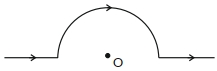
A straight wire carrying a current of $14\,A$ is bent into a semicircular are of radius $2.2\,cm$ as shown in the figure. The magnetic field produced by the current at the centre $(O)$ of the arc. is $.........\,\times 10^{-4}\, T$
In an experiment to study standing waves, you use a string whose mass per length is $μ$ = $(1.0 ± 0.1) × 10^{-4}\ kg/m$ . You look at the fundamental mode, whose frequency $f$ is related to the length $L$ and tension $T$ of the string by the following equation $L$ = $\frac{1}{{2f}}\sqrt {\frac{T}{\mu }} $ You make a plot with $L$ on the $y-$ axis and $\sqrt T$ on the $x-$ axis, and find that the best fitting line is $y$ = $(8.0 ± 0.3) × 10^{-3}x + (0.2 ± 0.04)$ in $SI\ units$ . What is the value of the frequency of the wave (including the error)? Express your result in $SI\ unit\ (Hz)$
An electron is accelerated through a potential difference of $1000$ volts. Its velocity is nearly
An electron is moving in the north direction. It experiences a force in vertically upward direction. The magnetic field at the position of the electron is in the direction of
Solid targets of different elements are bombarded by highly energetic electron beams. The frequency $(f)$ of the characteristic $X-$ rays emitted from different targets varies with atomic number $Z$ as