Three liquids of densities $d,\,2d$ and $3d$ are mixed in equal volumes. Then the density of the mixture is
Medium


Download our appand get started for free
Experience the future of education. Simply download our apps or reach out to us for more information. Let's shape the future of learning together!No signup needed.*
Similar Questions
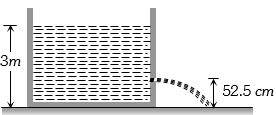
- 1Water is filled in a cylindrical container to a height of $3m. $ The ratio of the cross-sectional area of the orifice and the beaker is $ 0.1. $ The square of the speed of the liquid coming out from the orifice is ....... $m^2/s^2$ ($g = 10 m/s^2$)View Solution
- 2A river $10\,m$ deep is flowing at $5\,m/s$. The shearing stress between horizontal layers of the river is :- $(\eta = 10^{-3}\,SI\,unit)$View Solution
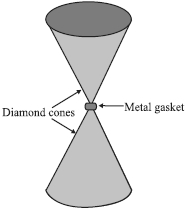
- 3Anvils made of single crystals of diamond, with the shape as shown in Figure, are used to investigate behaviour of materials under very high pressures. Flat faces at the narrow end of the anvil have a diameter of $0.50\; mm$, and the wide ends are subjected to a compressional force of $50,000 \;N$. What is the pressure at the tip of the anvil?View Solution
- 4Water is flowing through a horizontal tube having cross-sectional areas of its two ends being $A$ and $A'$ such that the ratio $A/A'$ is $5$ છે.જો If the pressure difference of water between the two ends is $3 \times 10^5\, N\, m^{-2}$, the velocity of water with which it enters the tube will be ......... $m s^{-1}$ (neglect gravity effects)View Solution
- 5A certain block weight $15\, N$ in air. It weight $12\, N$ when immersed in water when immersed in another liquid it weighs $13\, N$, the relative density of the block isView Solution
- 6The approximate depth of an ocean is $2700\,\, m.$ The compressibility of water is $45.4 \times 10^{-11} Pa^{-1}$ and density of water is $10^3 \,kg/m^3 $. What fractional compression of water will be obtained at the bottom of the ocean?View Solution
- 7Air is streaming past a horizontal air plane wing such that its speed in $ 120 m/s$ over the upper surface and $ 90 m/s$ at the lower surface. If the density of air is $1.3 kg$ per $metre^3 $ and the wing is $10 m $ long and has an average width of $2 m$, then the difference of the pressure on the two sides of the wing of ....... $Pascal$View Solution
- 8A rectangular vessel when full of water takes $10 $ minutes to be emptied through an orifice in its bottom. ......... $\min$ will it take to be emptied when half filled with waterView Solution
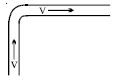
- 9A fire hydrant delivers water of density $\rho$ at a volume rate $L$. The water travels vertically upward through the hydrant and then does $90^o $ turn to emerge horizontally at speed $V$. The pipe and nozzle have uniform crosssection throughout. The force exerted by the water on the corner of the hydrant isView Solution
- 10A cylindrical tank of height $1$ $m$ and cross section area $A$ $=$ $4000$ $cm^2$ is initially empty when it is kept under a tap of cross sectional area $1$ $cm^2$. Water starts flowing from the tap at $t$ $=$ $0$, with a speed $= $ $2$ $m/s$. There is a small hole in the base of the tank of cross-sectional area $0.5$ $cm^2$. The variation of height of water in tank (in meters) with time $t$ is best depicted byView Solution