The temperature of a wire of length $1$ metre and area of cross-section $1\,c{m^2}$ is increased from $0°C$ to $100°C$. If the rod is not allowed to increase in length, the force required will be $(\alpha = {10^{ - 5}}/^\circ C$ and $Y = {10^{11}}\,N/{m^2})$
Medium


Download our appand get started for free
Experience the future of education. Simply download our apps or reach out to us for more information. Let's shape the future of learning together!No signup needed.*
Similar Questions
- 1A uniform wire of length $L$ and radius $r$ is twisted by an angle $\alpha$. If modulus of rigidity of the wire is $\eta,$ then the elastic potential energy stored in wire, is $.........$View Solution
- 2The compressibility of water is $4 \times {10^{ - 5}}$ per unit atmospheric pressure. The decrease in volume of $100$ cubic centimeter of water under a pressure of $100$ atmosphere will be ......... $cc$View Solution
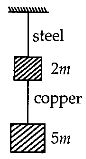
- 3If the ratio of diameters, lengths and Young's modulus of steel and copper wires shown in the figure are $p, q$ and $s$ respectively, then the corresponding ratio of increase in their lengths would beView Solution
- 4View SolutionA beam of metal supported at the two ends is loaded at the centre. The depression at the centre is proportional to
- 5Match the type of elasticity involvedView Solution
$(i)$ Suspension fibre of galvanometer $(a)$ Linear $(ii)$ Bending of beam $(b)$ Shear $(iii)$ cutting piece of paper $(c)$ Bulk $(iv)$ mechanical waves in fluid $(d)$ Shear - 6A cube of metal is subjected to a hydrostatic pressure of $4\;GPa.$ The percentage change in the length of the side of the cube is close to.......$\%$View Solution
(Given bulk modulus of metal, $B =8 \times 10^{10}\, Pa$ ) - 7Consider the situation shown in figure. The force $F$ is equal to the $m_2g/2.$ If the area of cross-section of the string is $A$ and its Young's modulus $Y$, find the strain developed in it. The string is light and there is no friction anywhereView Solution
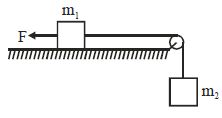
- 8A wire is stretched by $0.01$ $m$ by a certain force $F.$ Another wire of same material whose diameter and length are double to the original wire is stretched by the same force. Then its elongation will beView Solution
- 9A uniform heavy rod of mass $20\,kg$. Cross sectional area $0.4\,m ^{2}$ and length $20\,m$ is hanging from a fixed support. Neglecting the lateral contraction, the elongation in the rod due to its own weight is $x \times 10^{-9} m$. The value of $x$ isView Solution
(Given. Young's modulus $Y =2 \times 10^{11} Nm ^{-2}$ અને $\left.g=10\, ms ^{-2}\right)$
- 10When a block of mass $M$ is suspended by a long wire of length $L$, the length of the wire become $(L+l) .$ The elastic potential energy stoped in the extended wire is :View Solution