MCQ
The term 'fluid' is used for ............
  • A
    Liquids only
  • B
    Gases only
  • C
    A mixture of liquid and gas only
  • Both liquids and gases

Answer

Correct option: D.
Both liquids and gases
d
(d)

Substances that can flow is called fluid. Thus both liquids and gases are fluids.

Need a full question paper?

Generate a complete, print-ready paper with questions like this in minutes — across 16+ boards, with answer keys.
Start Generating Free

Similar questions

As one considers orbits with higher values of n in a hydrogen atom, the electric potential energy of the atom:
  1. Decreases.
  2. Increases.
  3. Remains the same.
  4. Does not increase.
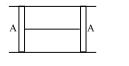
A cylindrical tube of cross-sectional area $A$ has two air tight frictionless pistons at its two ends. The pistons are tied with a straight two ends. The pistons are tied with a straight piece of metallic wire. The tube contains a gas at atmospheric pressure $P_0$ and temperature $T_0$. If temperature of the gas is doubled then the tension in the wire is
Radius of a soap bubble is increased from R to 2R. Work done in this process in terms of surface tension is:
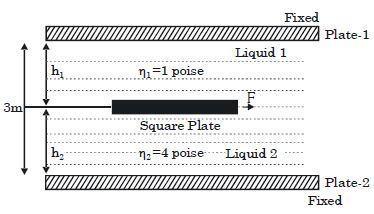
A thin square plate of side $2\ m$ is moving at the interface of two very viscous liquids of viscosities ${\eta _1} = 1$ poise and ${\eta _2} = 4$ poise respectively as shown in the figure. Assume a linear velocity distribution in each fluid. The liquids are contained between two fixed plates. $h_1 + h_2 = 3\ m$ . A force $F$ is required to move the square plate with uniform velocity $10\ m/s$ horizontally then the value of minimum applied force will be ........ $N$
The density of a non-uniform rod of length 1m is given by $\rho(\text{x})=\alpha(1+\text{b}\text{x}^2)$ where a and b are constants and $0\leq\text{x}\leq1$ The centre of mass of the rod will be at:

  1. $\frac{3(2+\text{b})}{4(3+\text{b})}$

  2. $\frac{4(2+\text{b})}{3(3+\text{b})}$

  3. $\frac{3(3+\text{b})}{4(2+\text{b})}$

  4. $\frac{4(3+\text{b})}{3(2+\text{b})}$

Consider two containers A and B containing identical gases at the same pressure, volume and temperature. The gas in container A is compressed to half of its original volume isothermally while the gas in container B is compressed to half of its original value adiabatically. The ratio of final pressure of gas in B to that of gas in A is

  1. $2^{\gamma-1}$

  2. $\Big(\frac{1}{2}\Big)^{\gamma-1}$

  3. $\Big(\frac{1}{1-\gamma}\Big)^2$

  4. $\Big(\frac{1}{\gamma-1}\Big)^2$

The end correction of a resonance column is $1\,cm.$  If the shortest length resonating with the tuning fork is $10\,cm,$  the next resonating length should be ..... $cm$
The instantaneous velocity of a body can be measured:
A pendulum has time period $T$ in air. When it is made to oscillate in water, it acquired a time period $T' = \sqrt 2 T$. The density of the pendulum bob is equal to (density of water $= 1$)
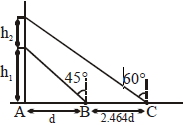
A balloon is moving up in air vertically above a point $A$ on the ground. When it is at a height $h _{1},$ a girl standing at a distance $d$ (point $B$ ) from $A$ (see figure) sees it at an angle $45^{\circ}$ with respect to the vertical. When the balloon climbs up a further height $h _{2},$ it is seen at an angle $60^{\circ}$ with respect to the vertical if the girl moves further by a distance $2.464\, d$ (point $C$ ). Then the height $h _{2}$ is (given tan $\left.30^{\circ}=0.5774\right)$$.......$