Question
Consider two containers A and B containing identical gases at the same pressure, volume and temperature. The gas in container A is compressed to half of its original volume isothermally while the gas in container B is compressed to half of its original value adiabatically. The ratio of final pressure of gas in B to that of gas in A is

  1. $2^{\gamma-1}$

  2. $\Big(\frac{1}{2}\Big)^{\gamma-1}$

  3. $\Big(\frac{1}{1-\gamma}\Big)^2$

  4. $\Big(\frac{1}{\gamma-1}\Big)^2$

Answer

  1. $2^{\gamma-1}$

Explanation:

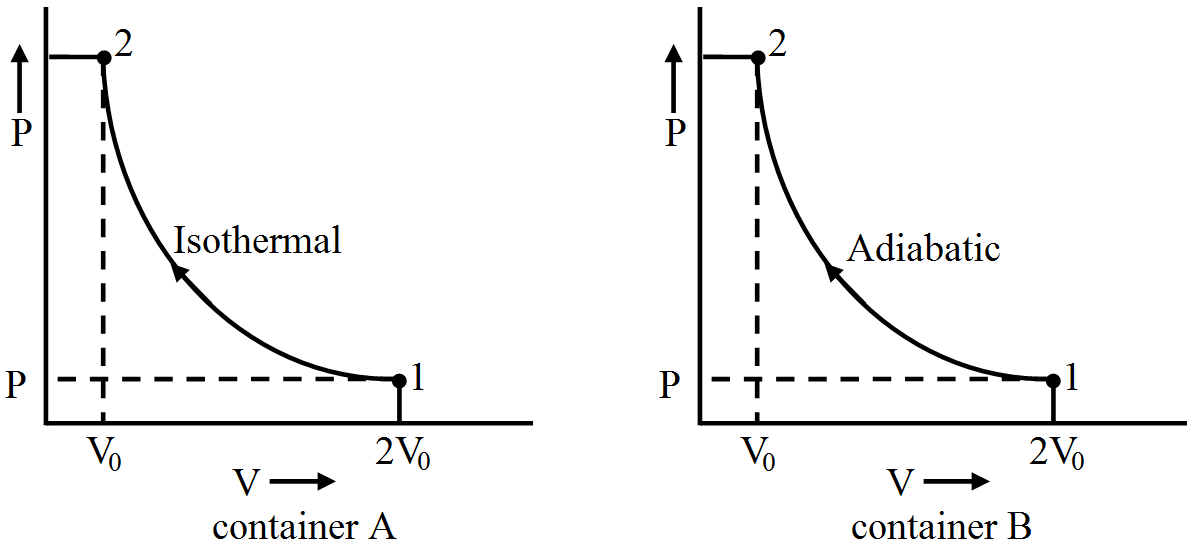
According to the P-V diagram shown for the container A (which is going through isothermal process) and for container B (which is going through adiabatic process).

Both the process involves compression of the gas.

(I) Isothermal compression (gas A) (during 1 → 2)

$\text{P}_{1}\text{V}_{1}=\text{P}_{2}\text{V}_{2}$

$\Rightarrow\text{P}_{0}(2\text{V}_{0})^\gamma=\text{P}_{2}(\text{V}_{0})^\gamma$

$\Rightarrow\text{P}_{0}(2\text{V}_{0})=\text{P}_{2}(\text{V}_{0})$

(ii) Adiabatic compression, (gas B) (during 1 → 2)

$\text{P}_{1}\text{V}_{1} ^\gamma=\text{P}_{2}\text{V}_{2}^\gamma$

$\text{P}_{0}(2\text{V}_{0})^\gamma=\text{P}_{2}(\text{V}_{0})^\gamma$

$\text{P}_{2}=\Big(\frac{2\text{V}_{0}}{\text{V}_{0}}\Big)^\gamma\text{P}_{0}=(2)^\gamma\text{P}_{0}$

Hence $\frac{(\text{P}_{2})_\text{B}}{(\text{P}_{2})_\text{A}}=$ Ratio of final pressure $=\frac{(2)^\gamma\text{P}_{0}}{2\text{P}_{0}}=2^{\gamma-1}$

where, $\gamma$ is ratio of specific heat capacities for the gas.

Need a full question paper?

Generate a complete, print-ready paper with questions like this in minutes — across 16+ boards, with answer keys.

Start Generating Free

Similar questions

In the figure shown, horizontal force $F_1$ is applied on a block but the block does not slide. Then as the magnitude of vertical force $F_2$ is increased from zero the block begins to slide; the correct statement is
Two pulley arrangements of figure given are identical. The mass of the rope is negligible. In fig $(a)$, the mass $m$ is lifted by attaching a mass $2\,m$ to the other end of the rope. In fig $(b)$, $m$ is lifted up by pulling the other end of the rope with a constant downward force $F = 2mg$. The acceleration of $m$ in the two cases are respectively
A spring with one end attached to a mass and the other to a rigid support is stretched and released.
  1. Magnitude of acceleration, when just released is maximum.
  2. Magnitude of acceleration, when at equilibrium position, is maximum.
  3. Speed is maximum when mass is at equilibrium position.
  4. Magnitude of displacement is always maximum whenever speed is minimum.
A particle moves $21\, m$ along the vector $6\hat i + 2\hat j + 3\hat k$ , then $14\, m$ along the vector $3\hat i - 2\hat j + 6\hat k$ . Its total displacement (in meters) is
Two masses $M$ and $m$ are connected by a weightless string. They are pulled by a force $F$ on a frictionless horizontal surface. The tension in the string will be
The total work done on a particle is equal to the change in its kinetic energy:
For a certain gas, the ratio of specific heats is given to be $\gamma = 1.5$. For this gas
Efficiency of an engine is $\eta_1$ at $\text{T}_1=200^\circ\text{C}$ and $\text{T}_2=0^\circ\text{C}$ and for $\eta_2$ at $\text{T}_1=0^\circ\text{C}$ and $\text{T}_2=-200\text{K},$ the ratio of $\frac{\eta_1}{\eta_2}$ is:
A wave represented by the equation ${y_1} = a\,\cos \,\left( {kx - \omega t} \right)$ is superimposed with another wave to form a stationary wave such that the point $x = 0$ is node. The equation for the other wave is
 A disc of radius $R$  is made to oscillate about a horizontal axis passing through its periphery. Its time period would be