MCQ
The theorem of perpendicular axes is applicable for:
  • Only planar bodies.
  • B
    Only regular shaped bodies.
  • C
    Only three dimensional bodies.
  • D
    None of the above.

Answer

Correct option: A.
Only planar bodies.
Theorem of perpendicular axes is applicable for planar bodies only.
We generally use this theorem for regular shaped bodies but it could be applied to irregular shaped bodies as well.

Need a full question paper?

Generate a complete, print-ready paper with questions like this in minutes — across 16+ boards, with answer keys.

Start Generating Free

Similar questions

Given that $\overrightarrow A + \overrightarrow B = \overrightarrow C $and that $\overrightarrow C $ is $ \bot $ to $\overrightarrow A $. Further if $|\overrightarrow A |\, = \,|\overrightarrow C |,$then what is the angle between $\overrightarrow A $ and $\overrightarrow B $
$List I$ describes thermodynamic processes in four different systems. $List II$ gives the magnitudes (either exactly or as a close approximation) of possible changes in the internal energy of the system due to the process.

$List-I$ $List-II$
($I$) $10^{-3} kg$ of water at $100^{\circ} C$ is converted to steam at the same temperature, at a pressure of $10^5 Pa$. The volume of the system changes from $10^{-6} m ^3$ to $10^{-3} m ^3$ in the process. Latent heat of water $=2250 kJ / kg$. ($P$) $2 kJ$
($II$) $0.2$ moles of a rigid diatomic ideal gas with volume $V$ at temperature $500 K$ undergoes an isobaric expansion to volume $3 V$. Assume $R=8.0 Jmol ^1 K^{-1}$. ($Q$) $7 kJ$
($III$) On mole of a monatomic ideal gas is compressed adiabatically from volume $V=\frac{1}{3} m^3$ and pressure $2 kPa$ to volume $\frac{v}{8}$ ($R$) $4 kJ$
($IV$) Three moles of a diatomic ideal gas whose molecules can vibrate, is given $9 kJ$ of heat and undergoes isobaric expansion. ($S$) $5 kJ$
  ($T$) $3 kJ$

Which one of the following options is correct?
A ring, a solid sphere and a thin disc of different masses rotate with the same kinetic energy. Equal torques are applied to stop them. Which will make the least number of rotations before coming to rest
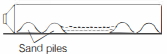
A closed pipe of length $300 \,cm$ contains some sand. A speaker is connected at one of its ends. The frequency of the speaker at which the sand will arrange itself in $20$ equidistant piles is close to .......... $kHz$ (velocity of sound is $300 \,m / s )$
A string fixed at both ends is in resonance in its $2^{nd}$ harmonic with a tuning fork of frequency $f_1$. Now its one end becomes free. If the frequency of the tuning fork is increased slowly from $f_1$ then again a resonance is obtained when the frequency is $f_2$. If in this case the string vibrates in $n^{th}$ harmonic then
The position vector of a particle is given as $\vec r\, = \,({t^2}\, - \,8t\, + \,12)\,\hat i\,\, + \,\,{t^2}\hat j$ The time after which velocity vector and acceleration vector becomes perpendicular to each other is equal to........$sec$
A car is moving with uniform velocity on a rough horizontal road. Therefore, according to Newton's first law of motion
Two particles $A$ and $B$ start from rest and move for equal time on a straight line. Particle $A$ has an acceleration of $2\,m / s ^2$ for the first half of the total time and $4\,m / s ^2$ for the second half. The particle $B$ has acceleration $4\,m / s ^2$ for the first half and $2\,m / s ^2$ for the second half. Which particle has covered larger distance?
For a particle performing uniform circular motion, choose the correct statement$(s)$ from the following:
Five moles of helium are mixed with two moles of hydrogen to form a mixture. Take molar mass of helium $M_1=4\ g$ and that of hydrogen $M_2=2\ g$ If the internal energy of He sample of $100\,\,J$ and that of the hydrogen sample is $200\,\,J$, then the internal energy of the mixture is ..... $J$