MCQ
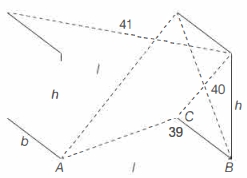
The three different face diagonals of a cuboid (rectangular parallelopiped) have lengths $39,40,41$. The length of the main diagonal of the cuboid which joins a pair of opposite corners is
  • $49$
  • B
    $49 \sqrt{2}$
  • C
    $60$
  • D
    $60 \sqrt{2}$

Answer

Correct option: A.
$49$
a
(a)

Let the length, breadth and height of cuboid is $l, b$ and $h$ respectively.

$Given, l^2+h^2=39^2$

$\Rightarrow b^2+h^2=40^2$

$\Rightarrow \quad l^2+b^2=41^2$

$\Rightarrow \quad 2\left(l^2+b^2+h^2\right)=39^2+40^2+41^2$

$\Rightarrow \quad l^2+b^2+h^2=2401$

$\therefore$ Length of longest diagonal

$=\sqrt{l^2+b^2+h^2}$

$=\sqrt{2401}=49$
Need a full question paper?

Generate a complete, print-ready paper with questions like this in minutes — across 16+ boards, with answer keys.

Start Generating Free

Similar questions

The sum of the rational terms in the binomial expansion of ${\left( {{2^{\frac{1}{2}}} + {3^{\frac{1}{5}}}} \right)^{10}}$ is
If A = (6, 7, 8, 9), B = (4, 6, 8, 10) and C = {x : x $\in$ N : 2 < x ≤ 7} ; find : B − B
The plane x = 0 divides the joinning of (-2, 3, 4) and (1, -2, 3) in the ratio:
The sum of all those terms, of the anithmetic progression $3,8,13, \ldots \ldots .373$, which are not divisible by $3$,is equal to $.......$.
If $y = 3\,sin\,x + 4\,cos\,x$ then find the maximum value of $y$
If the mean and variance of the data $65,68,58,44$, $48,45,60, \alpha, \beta, 60$ where $\alpha>\beta$ are $56$ and $66.2$ respectively, then $\alpha^2+\beta^2$ is equal to
If $\sqrt {a + ib} = x + iy$, then possible value of $\sqrt {a - ib} $is
The coordinates of a point are $(0, 1)$ and the ordinate of another point is -$3$. If the distance between the two points is $5$, then the abscissa of another point is
Let $\alpha$ and $\beta$ be the roots of $x^2-x-1=0$, with $\alpha>\beta$. For all positive integers $n$, define

$a_n=\frac{\alpha^n-\beta^n}{\alpha-\beta}, n \geq 1$

$b_1=1 \text { and } b_n=a_{n-1}+a_{n+1}, n \geq 2.$

Then which of the following options is/are correct?

$(1)$ $a_1+a_2+a_3+\ldots . .+a_n=a_{n+2}-1$ for all $n \geq 1$

$(2)$ $\sum_{n=1}^{\infty} \frac{ a _{ n }}{10^{ n }}=\frac{10}{89}$

$(3)$ $\sum_{n=1}^{\infty} \frac{b_n}{10^n}=\frac{8}{89}$

$(4)$ $b=\alpha^n+\beta^n$ for all $n>1$

If ${m_1}$ and ${m_2}$are the slopes of the tangents to the hyperbola $\frac{{{x^2}}}{{25}} - \frac{{{y^2}}}{{16}} = 1$ which pass through the point $(6, 2)$, then