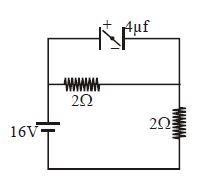
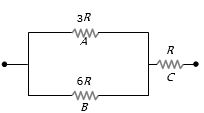
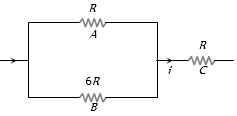
The three resistances $A, B$ and $C$ have values $3R, 6R$ and $R$ respectively. When some potential difference is applied across the network, the thermal powers dissipated by $A, B$ and $C$ are in the ratio
Medium


Download our appand get started for free
Experience the future of education. Simply download our apps or reach out to us for more information. Let's shape the future of learning together!No signup needed.*
Similar Questions
- 1Four resistances of $100$ $\Omega$ each are connected in the form of square. Then, the effective resistance along the diagonal points is .............. $\Omega$View Solution
- 2$n$ equal cell having emf $E$ and internal resistance $r$, are connected in a circuit of a resistance $R$ . Same current flows in circuit either they are connected in series or parallel, ifView Solution
- 3The resistance of a wire is$10\,\Omega $. Its length is increased by $10\%$ by stretching. The new resistance will now be .......... $\Omega$View Solution
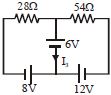
- 4Consider the circuit shown in the figure. The current $I_3$ is equal toView Solution
- 5The resistance of a wire is$10\,\Omega $. Its length is increased by $10\%$ by stretching. The new resistance will now be .......... $\Omega$View Solution
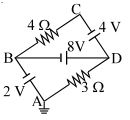
- 6The figure shows a network of resistances in which the point $A$ is earthed. The point which has the least potential isView Solution
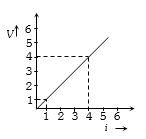
- 7Variation of current and voltage in a conductor has been shown in the diagram below. The resistance of the conductor is. ........... $ohm$View Solution
- 8Two $220\; V , 100 \;W$ bulbs are connected first in series and then in parallel. Each time the combination is connected to a $220 \;V \;AC$ supply line. The power drawn by the combination in each case respectively will beView Solution
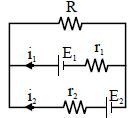
- 9View SolutionSee the electrical circuit shown in the adjoining figure. Which of the following equation is a correct equation for it
- 10What is net force on the small dipole placed inside the capacitor at steady state if the plates are separated by $1\ cm$ ?......$N$View Solution