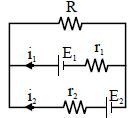
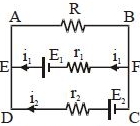
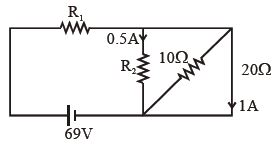
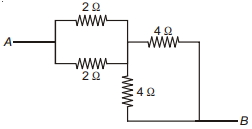
See the electrical circuit shown in the adjoining figure. Which of the following equation is a correct equation for it
Medium


Download our appand get started for free
Experience the future of education. Simply download our apps or reach out to us for more information. Let's shape the future of learning together!No signup needed.*
Similar Questions
- 1A current of $2\, mA$ was passed through an unknown resistor which dissipated a power of $4.4\, W$. Dissipated power when an ideal power supply of $11\, V$ is connected across it isView Solution
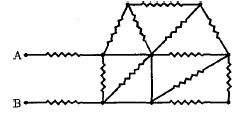
- 2Equivalent resistance between $A$ and $B$ will be ............ $ohm$View Solution
- 3In the circuit shown in the given figure the resistance $R_1$ and $R_2$ are respectivelyView Solution
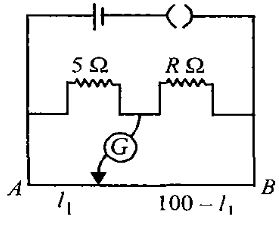
- 4The resistances in the two arms of the meter bridge are $5 \,\Omega$ and $R \,\Omega$ respectively. When the resistance $R$ is shunted with an equal resistance, the new balance point is at $1.6\,l_1$. The resistance $R$ is .................. $\Omega$View Solution
- 5The current in a conductor is expressed as $I=3 t^2+4 t^3$, where $I$ is in Ampere and $t$ is in second. The amount of electric charge that flows through a section of the conductor during $t=1$ s to $t=2 \mathrm{~s}$ is_______ C.View Solution
- 6Two wires have resistance of $2$ $\Omega$ and $4$ $\Omega$ connected to same voltage, ratio of heat dissipated at resistance isView Solution
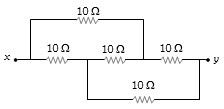
- 7The equivalent resistance between $x$ and $y$ in the circuit shown is ............. $\Omega$View Solution
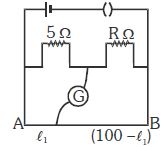
- 8The resistance in the two arms of a meter bridge are $5\,\Omega $ and $R\,\Omega $, respectively. When the resistance $R$ is shunted with an equal resistance, the new balance point is at $1.6\, l_1$. The resistance $‘R’$ is ................. $\Omega$View Solution
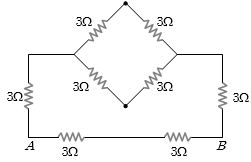
- 9Effective resistance across $A B$ in the network shown in .......... $\Omega$View Solution
- 10In the given circuit all resistances are of value $R\,ohm$ each. The equivalent resistance between $A$ and $B$ isView Solution